
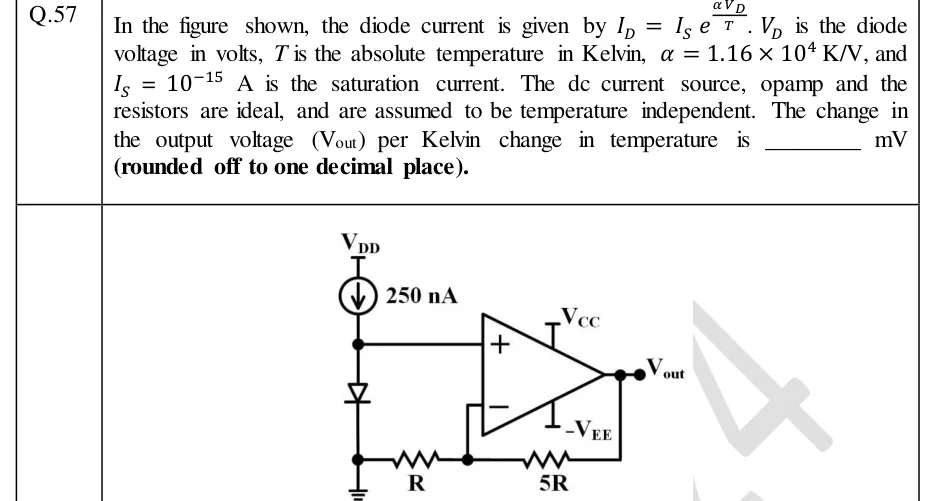
In the figure shown, the diode current is given by . is the diode voltage in volts, is the absolute temperature in Kelvin, , and is the saturation current. The dc current source, opamp and the resistors are ideal, and are assumed to be temperature independent. The change in the output voltage () per Kelvin change in temperature is ________ mV (rounded off to one decimal place).
 Tap to open full size
Figure description
A 250 nA dc current source hangs from V_DD and drives its current downward into a node (call it A). A diode runs from node A down to the bottom rail. The anode is at A and the cathode at the bottom rail, so the source current forward-biases it. The bottom rail is grounded. Node A also connects to the non-inverting (+) input of an op-amp powered from +V_CC and -V_EE. The op-amp output is V_out. A resistor 5R connects V_out to the inverting (-) input, and a resistor R connects the inverting (-) input to the grounded bottom rail (the diode's cathode). The circuit is a non-inverting amplifier that amplifies the diode voltage.