
IAE Academy

GATE 2026 EC Q.62: solution and answer

GATE 2026 · ECQ.62 · 2 marks · NAT

Consider an ideal OP-AMP circuit as shown in the Figure.

The resistances .

The magnitude of the closed loop gain is ____.

(rounded off to two decimal places)
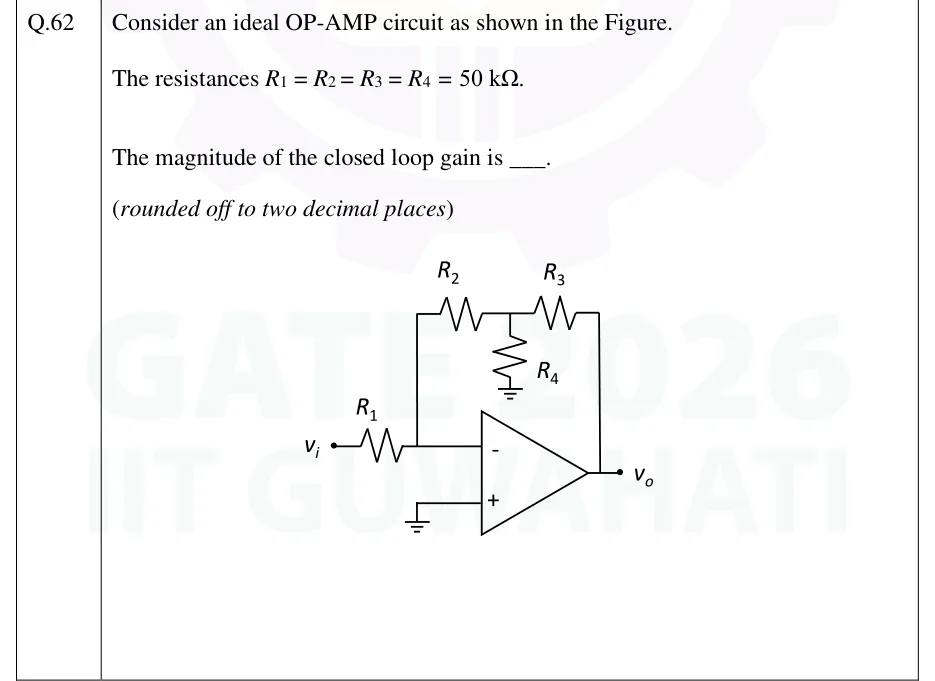
GATE 2026 EC question 62: Inverting amplifier with a T-network in the feedback path.Tap to open full size
Figure from the GATE 2026 EC paper. It is part of the question.
Figure description

Inverting amplifier with a T-network in the feedback path. Input v_i connects through R_1 to the inverting (−) input of an ideal op-amp. The non-inverting (+) input is grounded. From the inverting input, R_2 goes up to an intermediate node X; from X, R_4 goes down to ground; from X, R_3 goes to the op-amp output v_o. So the feedback path is R_2 (inverting input to X), then R_3 (X to output), with R_4 shunting X to ground. R_1 = R_2 = R_3 = R_4 = 50 k Ω. No supply rails shown.

Answer and solution

ANSWER

The closed-loop gain is , so its magnitude is 3.00.

Official answer: 2.90 to 3.10Source: Official answer key, GATE 2026 EC (IIT Guwahati)

  1. Assume an ideal op-amp: infinite open-loop gain and no input current. The (+) input is grounded, so negative feedback holds the (−) input at virtual ground, .

  2. KCL at the inverting input: no current enters the op-amp, so all of the current through continues through towards the T-node X:

  3. KCL at the T-node X. The current arriving through leaves through to ground and through to the output:

  4. Solve for :

  5. Substitute to get . Check against the standard T-network result:

  6. The closed-loop gain is , so its magnitude is .

KEY IDEA

This is an inverting amplifier whose feedback resistor has been replaced by a T-network. Virtual ground at the (−) input fixes the voltage at the T-node, . KCL at the T-node then gives . The general result is : the shunt resistor adds the term , which raises the gain above what alone would give.

WATCH OUT FOR

One mistake is to treat the feedback as a simple series resistor and ignore , which gives a gain of magnitude 2. Another is to treat as a load that can be dropped. takes current away from the T-node, so the output has to swing further to push the same current through . It adds the term and brings the gain to 3. A third error is to take the voltage at the (−) input as , when with the (+) input grounded it is at virtual ground (0 V).

From the GATE 2026 EC paper. Every question of this paper · Download the full paper · All 36 Op-amps questions, with notes

More Op-amps questions