
IAE Academy

GATE 2026 EE Q.37: solution and answer

GATE 2026 · EEQ.37 · 2 marks · MCQ

In the circuit shown, the open loop gain of the operational amplifier is .

What is the voltage gain of the circuit?

(Round off to two decimal places)
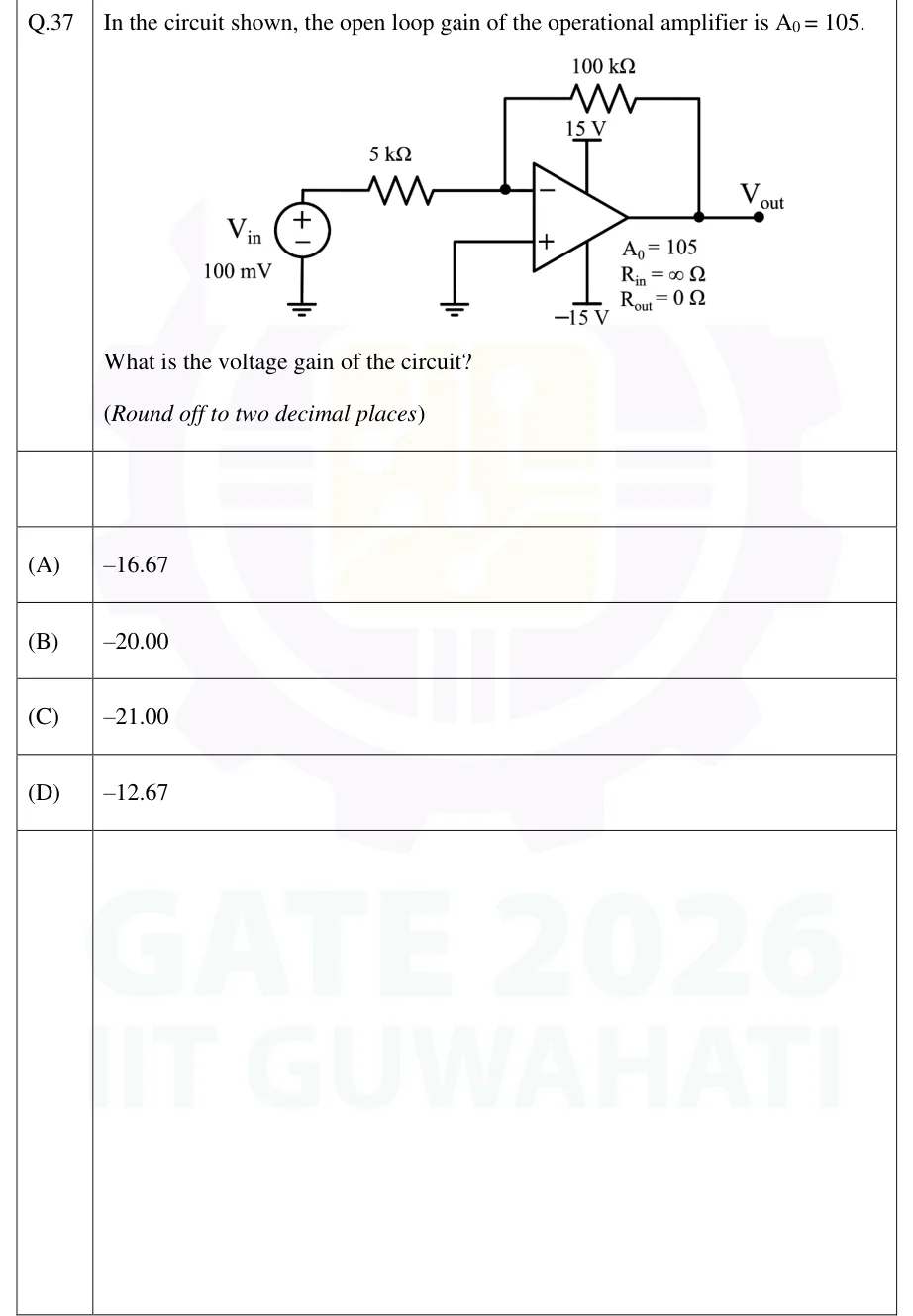
GATE 2026 EE question 37: Inverting amplifier.Tap to open full size
Figure from the GATE 2026 EE paper. It is part of the question.
Figure description

Inverting amplifier. An independent voltage source V_in = 100 mV has its + terminal at the top and its − terminal connected to ground. From the + terminal, a 5 kΩ resistor goes to the inverting (−) input of an op-amp. A 100 kΩ feedback resistor connects the inverting input to the op-amp output. The non-inverting (+) input is connected directly to ground. The op-amp's upper supply pin is labelled 15 V and its lower supply pin −15 V. The output node is labelled V_out. Printed beside the op-amp: A_0 = 105, R_in = ∞ Ω, R_out = 0 Ω.

  1. (A)

  2. (B)

  3. (C)

  4. (D)

Answer and solution

ANSWER

The voltage gain is , so the answer is option (A).

Official answer: ASource: Official answer key, GATE 2026 EE (IIT Guwahati)

  1. Model. The op-amp has a finite open-loop gain (printed as 105, not ), with and . So no current flows into either input, and exactly. Because is finite, there is no virtual short: is small but not zero.

  2. Input relation. The non-inverting input is grounded, so . Call the inverting-input voltage . Then , which gives .

  3. KCL at the inverting node. , so all the current through the 5 kΩ resistor also flows through the 100 kΩ resistor:

  4. Simplify. Multiply both sides by : , so . Substitute :

  5. Closed-loop gain.

  6. Cross-check with feedback theory. The feedback factor is , so the loop gain is . The ideal gain is . Scaling it by gives , the same result.

  7. Saturation check. . That is well inside the rails, so the op-amp stays linear and the gain holds. (The inverting input sits at , which is clearly not a virtual ground.) Answer: (A).

KEY IDEA

When the open-loop gain is finite, drop the virtual-ground assumption and use together with KCL at the inverting node. For an inverting amplifier this gives . The noise gain (that is, ) is what gets divided by .

WATCH OUT FOR

Assuming an ideal op-amp (virtual ground) and writing , which is option (B). This is the answer you also get if you read the printed 105 as , since . The paper prints 105, and with a loop gain of only the finite gain matters. Another slip is using the non-inverting formula (option C), which mixes up the noise gain with the signal gain.

From the GATE 2026 EE paper. Every question of this paper · Download the full paper · All 36 Op-amps questions, with notes

More Op-amps questions