
IAE Academy

GATE 2025 IN Q.20: solution and answer

GATE 2025 · INQ.20 · 1 mark · MCQ

For the ideal opamp based circuit shown in the figure, the ratio is
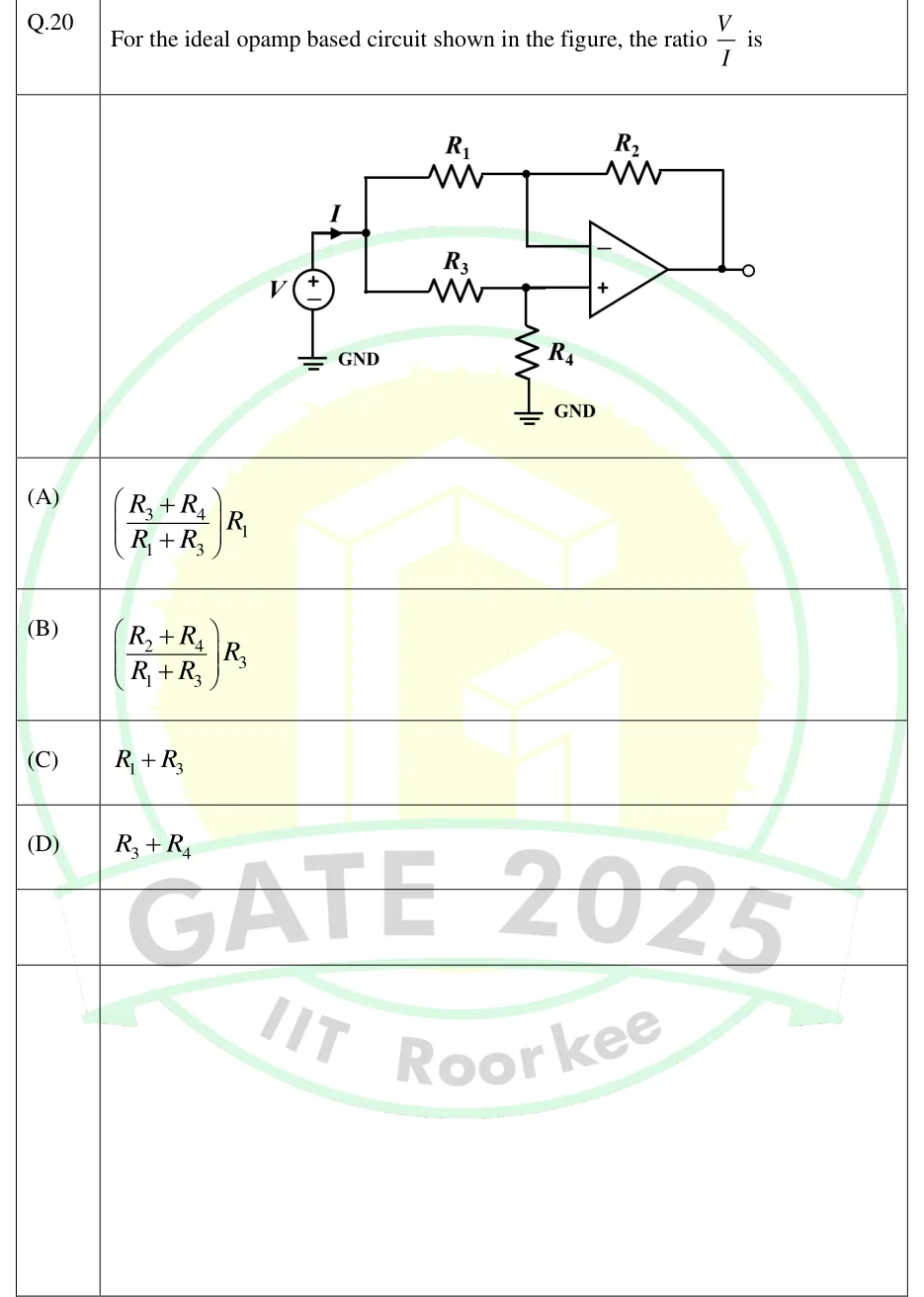
GATE 2025 IN question 20: An independent voltage source V (+ on top, − terminal to GND) drives a current I (arrow pointing right, out of the +…Tap to open full size
Figure from the GATE 2025 IN paper. It is part of the question.
Figure description

An independent voltage source V (+ on top, − terminal to GND) drives a current I (arrow pointing right, out of the + terminal) into a node A. Two branches leave node A. Upper branch: resistor R_1 from A to a node N; node N connects to the inverting (−) input of an ideal op-amp, and resistor R_2 connects node N to the op-amp output (feedback path). Lower branch: resistor R_3 from A to a node P; node P connects to the non-inverting (+) input of the op-amp, and resistor R_4 connects node P to GND. The op-amp output goes to an open output terminal. No supply rails are drawn.

  1. (A)

  2. (B)

  3. (C)

  4. (D)

Answer and solution

ANSWER

, which is option (A).

Official answer: ASource: Official answer key, GATE 2025 IN (IIT Roorkee)

  1. Assumptions. Ideal op-amp: no current flows into either input terminal. connects the output back to the inverting input, so there is negative feedback, and the two inputs sit at the same voltage (virtual short): .

  2. Lower branch (voltage divider). The + input draws no current, so and carry the same current:

  3. Virtual short. .

  4. Upper branch. Only the voltage across sets the current through it: No current enters the − input, so all of flows on through into the op-amp output. only sets the output voltage and has no effect on .

  5. KCL at the input node.

  6. Result. This is option (A).

  7. Check. Put . Then , both and end at (virtual) ground, and the source sees . The formula gives , the same value.

KEY IDEA

The source feeds two branches. The lower one (, ) is a plain divider because the + input draws no current, and it fixes . The virtual short copies onto the − input, so the current in is set by alone. is the sum of the two branch currents, and never enters it.

WATCH OUT FOR

Two common slips. The first is treating the − input as virtual ground (true only when the + input is grounded), which gives and the wrong answer. The second is letting into (as option (B) does), when all does is set the output voltage. Only the lower branch loads the source as a simple series resistance , so option (D) misses the current through .

From the GATE 2025 IN paper. Every question of this paper · Download the full paper · All 36 Op-amps questions, with notes

More Op-amps questions