
IAE Academy

GATE 2024 EE Q.61: solution and answer

GATE 2024 · EEQ.61 · 2 marks · NAT

A difference amplifier is shown in the figure. Assume the op-amp to be ideal. The CMRR (in dB) of the difference amplifier is ________ (rounded off to 2 decimal places).
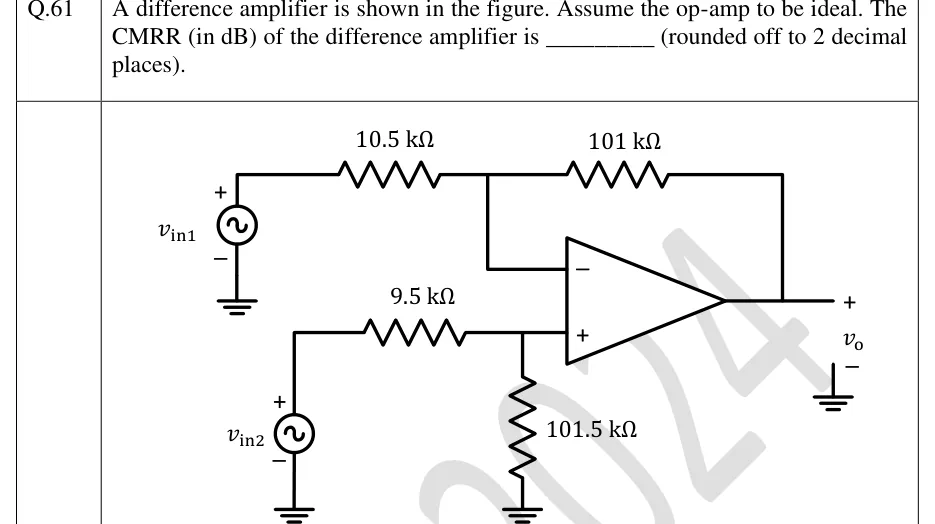
GATE 2024 EE question 61: Single op-amp difference amplifier.Tap to open full size
Figure from the GATE 2024 EE paper. It is part of the question.
Figure description

Single op-amp difference amplifier. Source v_in1 (+ terminal at top, − terminal to ground) connects through a 10.5 k Ω resistor to the op-amp's inverting (−) input. A 101 k Ω feedback resistor runs from the inverting input to the output v_o. Source v_in2 (+ at top, − to ground) connects through a 9.5 k Ω resistor to the non-inverting (+) input. A 101.5 k Ω resistor runs from the non-inverting input to ground. Output v_o is measured from the output node to ground (+ at the output).

Answer and solution

ANSWER

The CMRR of the difference amplifier is about 40.51 dB (ratio about 106.02).

Official answer: 39.50 to 41.50Source: Official answer key, GATE 2024 EE (IISc Bengaluru)

  1. Assume an ideal op-amp: virtual short, so , and no current into either input. By superposition, where , , and .

  2. Gain from (inverting path): .

  3. Gain from (non-inverting path): .

  4. Split the inputs into differential and common-mode parts: and . Substituting into gives .

  5. Common-mode gain: . It is not zero because the resistor ratios are mismatched: while .

  6. Differential gain: .

  7. Ratio (the common denominator cancels): .

  8. Convert to decibels:

KEY IDEA

With an ideal op-amp, the output is , where and . The two gains are equal and opposite only when . Any mismatch leaves a common-mode gain alongside the differential gain , and , expressed in dB as of that ratio. Here the op-amp is ideal, so the finite CMRR comes entirely from the mismatched resistors.

WATCH OUT FOR

Three common slips. (1) Taking as just (or ), which only holds for a matched bridge, and so getting a wrong ratio. (2) Leaving out the factor in the non-inverting path. (3) Rounding and to two or three digits before subtracting them. is the small difference of two nearly equal numbers, so early rounding throws the CMRR off badly. Keep exact fractions over the common denominator until the last step. Using instead of for this voltage-gain ratio is another way to land outside the key.

From the GATE 2024 EE paper. Every question of this paper · Download the full paper · All 36 Op-amps questions, with notes

More Op-amps questions