
IAE Academy

GATE 2023 EE Q.37: solution and answer

GATE 2023 · EEQ.37 · 2 marks · MCQ

Consider the OP AMP based circuit shown in the figure. Ignore the conduction drops of diodes and . All the components are ideal and the breakdown voltage of the Zener is 5 V. Which of the following statements is true?
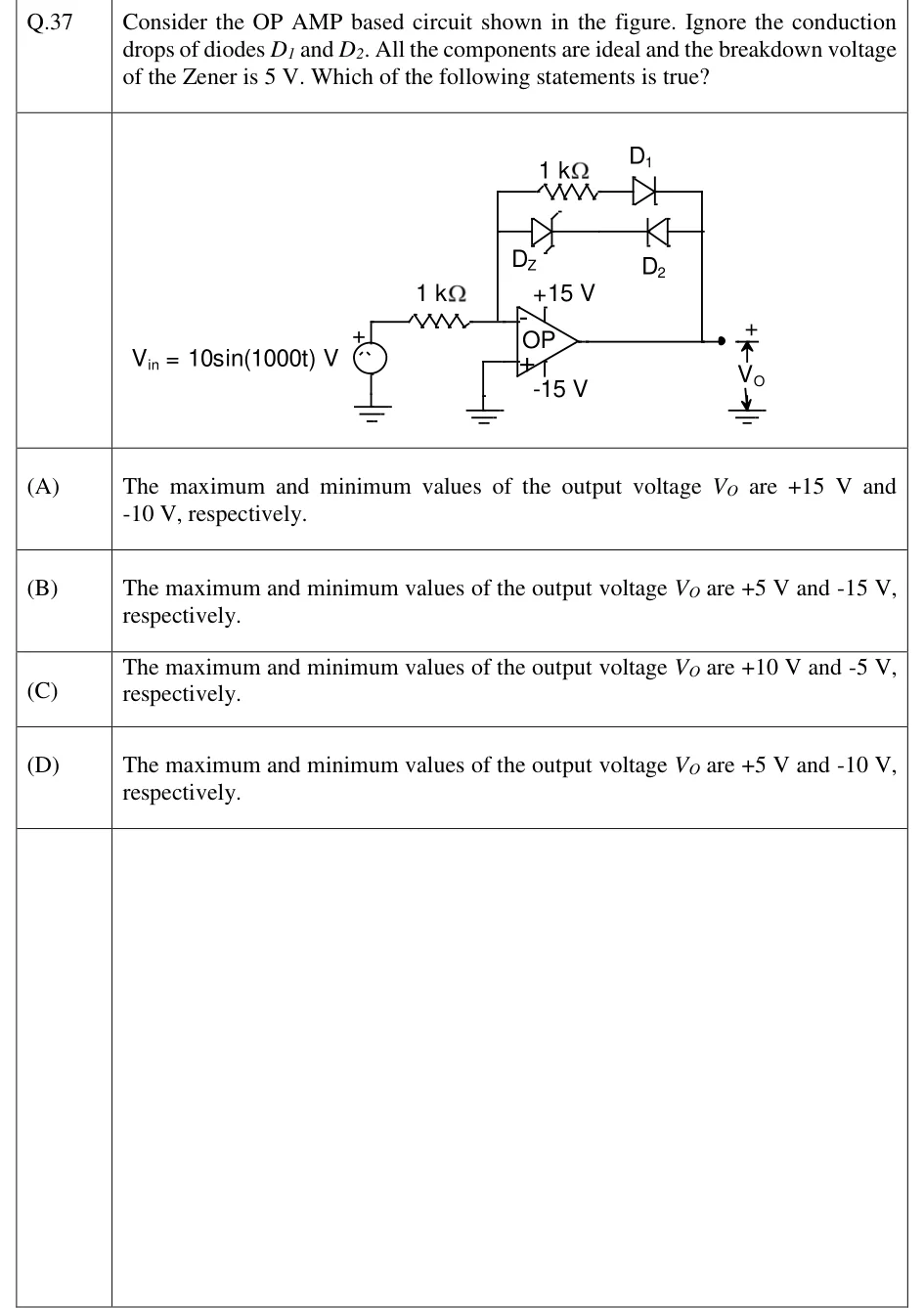
GATE 2023 EE question 37: Inverting op-amp circuit.Tap to open full size
Figure from the GATE 2023 EE paper. It is part of the question.
Figure description

Inverting op-amp circuit. Source V_in = 10 sin (1000t) V (+ terminal up, − terminal to ground) feeds a 1 kΩ resistor into the inverting (−) input of an op-amp labelled OP, powered from +15 V and −15 V rails. The non-inverting (+) input is grounded. The output node is labelled V_O (measured with respect to ground, + at the top). Between the inverting input and the output are two parallel feedback branches. Top branch: a 1 kΩ resistor in series with diode D_1, whose anode is on the inverting-input side and cathode on the output side. Lower branch: Zener diode D_Z in series with diode D_2; the Zener's anode is on the inverting-input side and its cathode faces D_2; D_2's cathode faces the Zener and its anode is on the output side (so the two diodes are cathode-to-cathode).

  1. (A)

    The maximum and minimum values of the output voltage are +15 V and -10 V, respectively.

  2. (B)

    The maximum and minimum values of the output voltage are +5 V and -15 V, respectively.

  3. (C)

    The maximum and minimum values of the output voltage are +10 V and -5 V, respectively.

  4. (D)

    The maximum and minimum values of the output voltage are +5 V and -10 V, respectively.

Answer and solution

ANSWER

(D) The maximum and minimum values of the output voltage are and , respectively.

Official answer: DSource: Official answer key, GATE 2023 EE (IIT Kanpur)

  1. Assumptions: ideal op-amp, ideal diodes and (zero forward drop, as stated), and an ideal Zener with . While a feedback path conducts, the inputs are at virtual ground, so . The input current is then flowing into the node, and none of it enters the op-amp.

  2. Check which way each feedback branch conducts. The branch of in series with (anode on the node side) conducts only from the node to the output, which needs . The – branch (cathode to cathode) conducts only from the output to the node. That needs forward-biased and the Zener in breakdown, so . In the other direction this branch is blocked, because is then reverse-biased.

  3. Positive half-cycle, : the current has to leave the node through the feedback, from the node to the output. Only the branch allows this, so conducts and the Zener branch is off. The circuit is an inverting amplifier: Check: here, as 's conduction requires, and the Zener branch sees in its blocked direction.

  4. Minimum output: at the positive peak , . This is inside the rail, so the op-amp does not saturate.

  5. Negative half-cycle, : current now flows out of the node toward the source, so the feedback must push current into the node from the output. blocks that direction. With no feedback path the op-amp is momentarily open-loop, and its output rises until the Zener branch conducts. At that point is forward-biased and the Zener is in breakdown, which clamps the output: Check: now has its cathode at and its anode side at , so it is reverse-biased and stays off.

  6. The Zener carries , up to at the negative peak, and stays at for the whole negative half-cycle. This is below the rail, so there is no saturation. Therefore and , which is option (D).

KEY IDEA

Each feedback branch conducts in only one direction. For , the – branch makes the circuit a unity-gain inverting amplifier, so and it reaches . For , the –Zener branch clamps the output at . Neither case reaches a rail, so the supplies are distractors.

WATCH OUT FOR

Thinking the op-amp saturates at in the negative half-cycle because is off, which leads to option (A). This overlooks the –Zener path, which closes the loop at . Two other slips give the wrong numbers: misreading the Zener's orientation, so the clamp lands on the negative half (option C), or letting the positive half-cycle run to the rail (option B) instead of following the unity-gain relation .

From the GATE 2023 EE paper. Every question of this paper · Download the full paper · All 36 Op-amps questions, with notes

More Op-amps questions