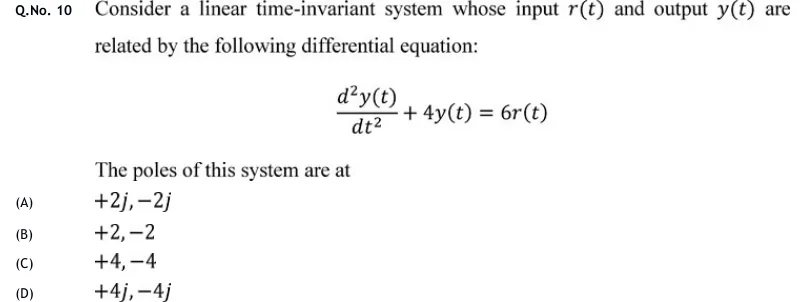
Consider a linear time-invariant system whose input and output are related by the following differential equation:
The poles of this system are at
- (A)
- (B)
- (C)
- (D)

Consider a linear time-invariant system whose input and output are related by the following differential equation:
The poles of this system are at
ANSWER
The transfer function is , so the poles are at and . The answer is option (A).
Official answer: ASource: Official answer key, GATE 2020 EE (IIT Delhi)
Take the Laplace transform with zero initial conditions, since a transfer function is defined that way: .
Transfer function: The gain of 6 in the numerator scales the response but has no effect on where the poles are.
The poles are the roots of the denominator, i.e. of the characteristic equation: .
. Comparing with gives and . The system is undamped: it has a pair of simple conjugate poles on the imaginary axis, so it is marginally stable and oscillates steadily at .
The poles are at and , which is option (A).
KEY IDEA
Poles come only from the left-hand (output) side of the differential equation: its Laplace transform gives the characteristic polynomial . The missing term means , so the poles sit on the imaginary axis at with . The input-side gain of 6 plays no part.
WATCH OUT FOR
One slip is solving in place of , which gives the real pair (option B). Another is reading the coefficient 4 as the pole location, which gives or (options C and D), even though 4 is , not . A third is letting the right-hand-side gain of 6 affect the poles.
From the GATE 2020 EE paper. Every question of this paper · Download the full paper · All 10 Block diagrams & SFG questions, with notes