
IAE Academy

GATE 2024 EE Q.20: solution and answer

GATE 2024 · EEQ.20 · 1 mark · MCQ

For the block-diagram shown in the figure, the transfer function is
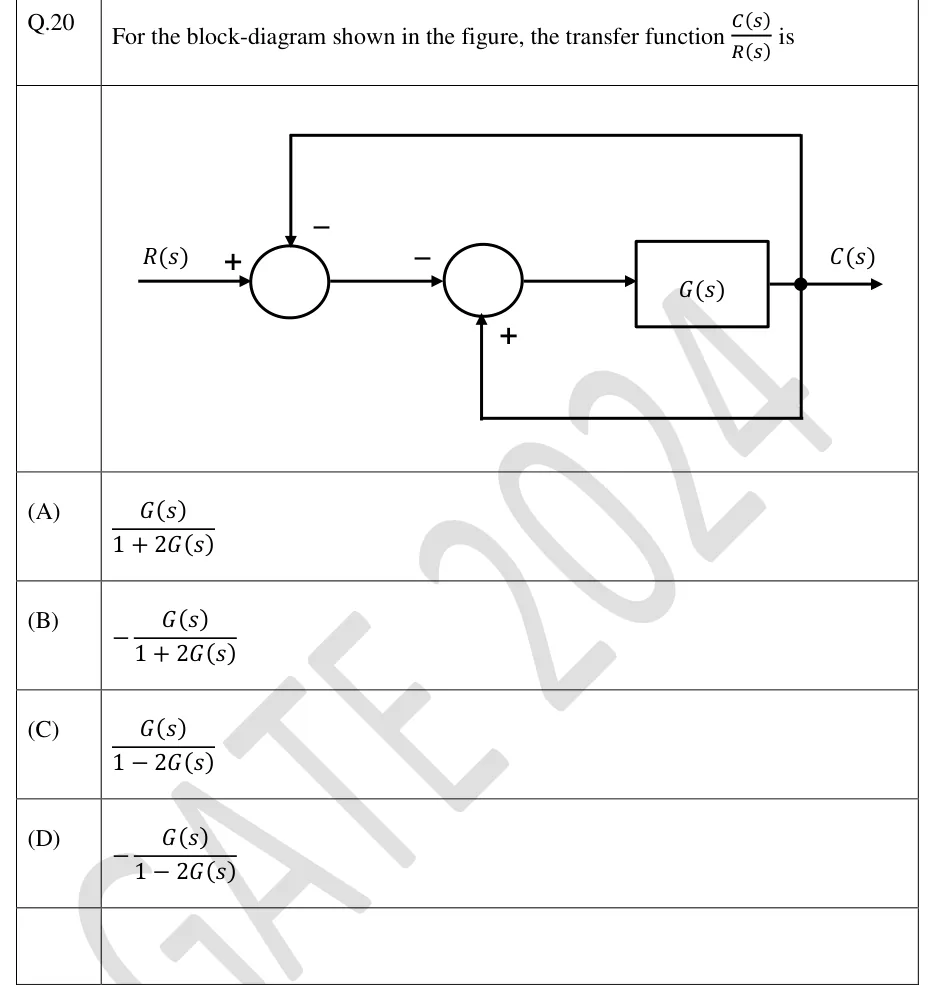
GATE 2024 EE question 20: Two summing junctions in cascade followed by a single forward block G(s).Tap to open full size
Figure from the GATE 2024 EE paper. It is part of the question.
Figure description

Two summing junctions in cascade followed by a single forward block G(s). R(s) enters the first (left) summing junction with a + sign. The output of the first junction goes to the second summing junction, and that input carries a − sign. The output of the second junction feeds the block G(s), and the block's output is C(s). From a take-off point at C(s) there are two feedback paths. (1) The upper path goes back to the top of the first summing junction with a − sign, which is unity negative feedback. (2) The lower path goes back to the bottom of the second summing junction with a + sign, which is unity positive feedback. Neither feedback path has a block in it, so both have unity gain.

  1. (A)

  2. (B)

  3. (C)

  4. (D)

Answer and solution

ANSWER

, option (D).

Official answer: DSource: Official answer key, GATE 2024 EE (IISc Bengaluru)

  1. First summing junction: enters with and the outer unity feedback enters with , so its output is .

  2. Second summing junction: enters with a minus sign and the inner unity feedback enters with a plus sign, so .

  3. Forward block: .

  4. Collect the terms in : , so .

  5. Check with Mason's gain formula. The one forward path passes through the input of the second junction, so . There are two loops. The inner loop goes through the input of the second junction: . The outer loop goes through the input of the first junction and the input of the second: . Both loops share the block , so they touch each other and the forward path. Hence and , giving . This is option (D).

KEY IDEA

The minus sign on the link between the two summing junctions lies on both the forward path and the outer loop. It makes the forward gain negative (). In the outer loop it cancels the minus at the first junction, so that loop is effectively positive (), the same as the inner positive-feedback loop. Two touching loops give .

WATCH OUT FOR

Counting the minus sign between the junctions only once. If you apply it to the outer loop but forget it on the forward path, you get , which is option (C). If you ignore it in the outer loop and read that loop as ordinary negative feedback, the loop signs come out wrong and you land on a denominator (options A and B) or on a result that is none of the options. That minus has to be counted in every path and loop that passes through it.

From the GATE 2024 EE paper. Every question of this paper · Download the full paper · All 10 Block diagrams & SFG questions, with notes

More Block diagrams & SFG questions