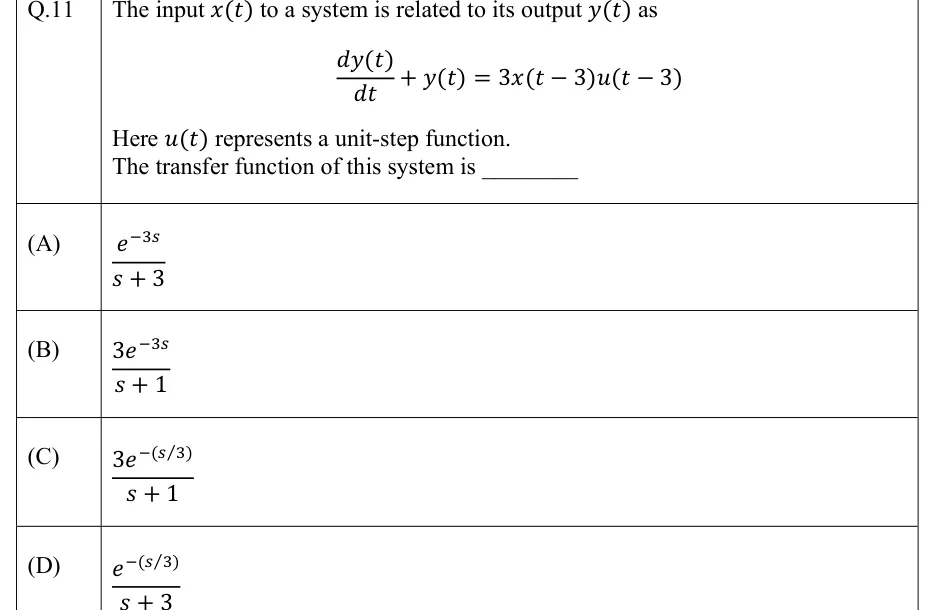
The input to a system is related to its output as
Here represents a unit-step function. The transfer function of this system is ________
- (A)
- (B)
- (C)
- (D)

The input to a system is related to its output as
Here represents a unit-step function. The transfer function of this system is ________
ANSWER
The transfer function is , which is option (B).
Official answer: BSource: Official answer key, GATE 2022 IN (IIT Kharagpur)
A transfer function is defined with all initial conditions zero, so take the Laplace transform of both sides with .
Differentiation property: . The left side therefore becomes .
Time-shift property: for a causal input, . The factor is a constant gain and passes straight through, so the right side becomes .
Equate the two sides:
Divide through by and by : This is a first-order lag with its pole at , a DC gain of , and a pure transport delay of . That is option (B).
KEY IDEA
A delay of seconds in time becomes a multiplying factor in the -domain, because . The delay changes the exponent only. The gain and the pole at come from the rest of the differential equation, so the answer is a gain of 3, a first-order lag , and a delay factor multiplied together.
WATCH OUT FOR
Two traps match the wrong options. (1) Treating the time shift like time scaling and writing . That factor would come from -type manipulations, not from a shift, and it gives options (C) and (D). (2) Letting the input coefficient move into the denominator and writing . The multiplies the input, so it sets the gain. The coefficient of is , so the pole stays at . That mistake gives options (A) and (D).
From the GATE 2022 IN paper. Every question of this paper · Download the full paper · All 10 Block diagrams & SFG questions, with notes