
IAE Academy

GATE 2022 EE Q.38: solution and answer

GATE 2022 · EEQ.38 · 2 marks · MCQ

The open loop transfer function of a unity gain negative feedback system is given as

The Nyquist contour in the -plane encloses the entire right half plane and a small neighbourhood around the origin in the left half plane, as shown in the figure below. The number of encirclements of the point by the Nyquist plot of , corresponding to the Nyquist contour, is denoted as . Then equals to
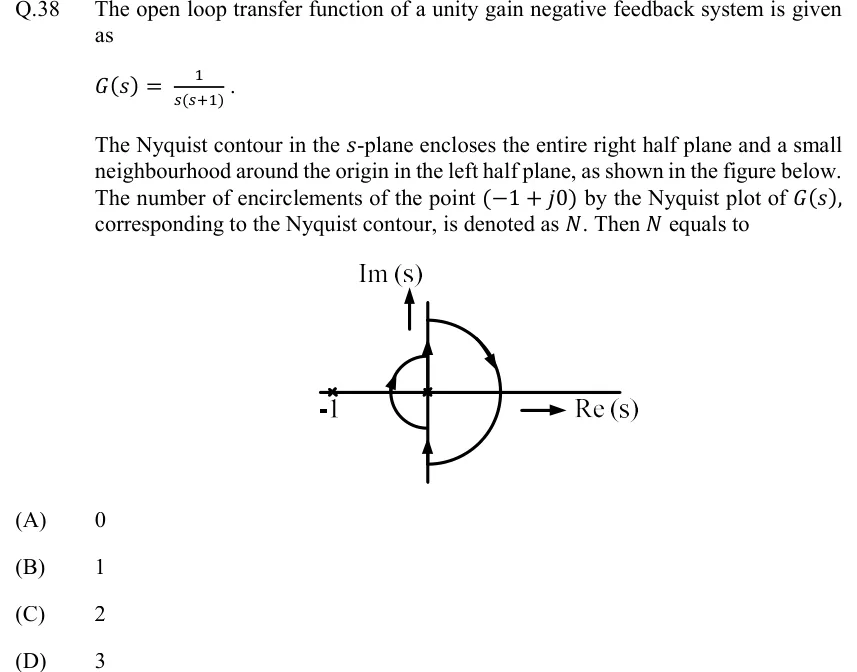
GATE 2022 EE question 38: The s-plane has a horizontal axis labelled Re(s) with an arrow pointing right, and a vertical axis labelled Im(s) with an…Tap to open full size
Figure from the GATE 2022 EE paper. It is part of the question.
Figure description

The s-plane has a horizontal axis labelled Re(s) with an arrow pointing right, and a vertical axis labelled Im(s) with an arrow pointing up. Open-loop poles are marked with crosses at s = -1 (labelled -1) and at s = 0 (the origin). The Nyquist contour runs up the imaginary axis from -j infinity, with an upward arrow on the lower segment. Just below the origin it leaves the axis and goes round the origin on a small semicircle that bulges into the LEFT half plane. The semicircle passes to the left of the origin but to the right of -1, with an arrow on its upper-left part. The contour rejoins the axis just above the origin and continues up the imaginary axis, with an upward arrow, to +j infinity. It then returns along a large semicircle in the right half plane, drawn clockwise with an arrow on its upper-right part, from +j infinity through the positive real axis to -j infinity. The whole contour is traversed clockwise. It encloses the pole at the origin but not the pole at -1.

  1. (A)

    0

  2. (B)

    1

  3. (C)

    2

  4. (D)

    3

Answer and solution

ANSWER

The Nyquist plot goes round exactly once, counter-clockwise, so : option (B).

Official answer: BSource: Official answer key, GATE 2022 EE (IIT Kharagpur)

  1. Open-loop poles inside the contour. has poles at and . The small indentation bulges into the left half plane, so the pole at the origin lies inside the contour. The indentation passes to the right of , so that pole lies outside. Therefore .

  2. Closed-loop poles inside the contour. Setting gives , so . Both roots are in the left half plane at distance from the origin, well outside the small neighbourhood of the origin. Therefore .

  3. Nyquist criterion. The contour is traversed clockwise. Count encirclements of as positive when they are clockwise. Then which means one encirclement, counter-clockwise.

  4. Check by mapping, segment . The plot starts at along the asymptote and ends at the origin. For every the real part lies strictly between and and the imaginary part is negative, so this branch never crosses the negative real axis.

  5. Small left-side arc. On the arc , goes , which is clockwise about the origin. There , and its angle goes . Check at the ends: , , . So the arc maps to an infinite-radius arc traced counter-clockwise from through to . It passes to the left of .

  6. Close the plot. The half is the mirror image of the branch: it runs from the origin up to . The large -plane semicircle maps to the origin. In order, the closed curve goes origin origin. Seen from , the angle increases by a full , so the curve goes round exactly once, counter-clockwise. This agrees with from the criterion. The number of encirclements is , which is option (B).

KEY IDEA

Where the contour is indented decides . Here the indentation goes into the left half plane, so the pole at the origin is inside the contour and . The closed loop is stable, so . Then : one counter-clockwise encirclement of . On the plot, the small left-side arc maps to an infinite arc swept counter-clockwise on the left, and that arc wraps round .

WATCH OUT FOR

Using the usual textbook contour, which indents to the right of the origin. That leaves the origin pole outside, gives , and leads to (option A). With the indentation drawn to the left, . The small arc then maps to an infinite arc on the left, passing through , instead of one on the right, and it encircles once. A second trap is the sign: means one counter-clockwise encirclement. The number of encirclements is still .

From the GATE 2022 EE paper. Every question of this paper · Download the full paper · All 11 Nyquist questions, with notes

More Nyquist questions