
IAE Academy

GATE 2018 EE Q.54: solution and answer

GATE 2018 · EEQ.54 · 2 marks · NAT

The equivalent circuit of a single phase induction motor is shown in the figure, where the parameters are , and is the slip. At no-load, the motor speed can be approximated to be the synchronous speed. The no-load lagging power factor of the motor is____________ (up to 3 decimal places).
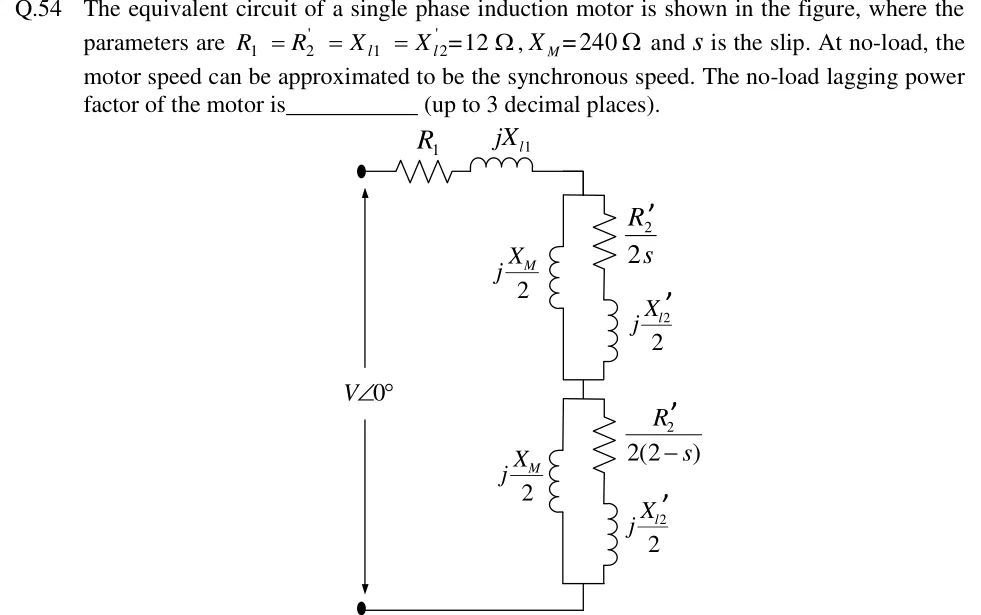
GATE 2018 EE question 54: Single-phase induction motor per-phase equivalent circuit (double revolving field model).Tap to open full size
Figure from the GATE 2018 EE paper. It is part of the question.
Figure description

Single-phase induction motor per-phase equivalent circuit (double revolving field model). Source: a voltage source V ∠ 0° on the left, with an arrow showing current flowing up into the circuit from its top terminal. In series from the top terminal: stator resistance R_1, then stator leakage reactance jX_l1. This series combination connects to two impedance blocks stacked in series (top block = forward field, bottom block = backward field), which then return to the bottom terminal of the source. Top (forward) block: a parallel combination of (a) j(X_M)/(2) (magnetizing branch) and (b) a series branch of (R_2')/(2s) and j X_l2'2. Bottom (backward) block: a parallel combination of (a) j(X_M)/(2) and (b) a series branch of (R_2')/(2(2-s)) and j X_l2'2. All parallel branches drawn as ladder rungs between the top node (junction of the two blocks) / outer rails and the bottom rail leading back to the source.

Answer and solution

ANSWER

The no-load lagging power factor is 0.106.

Official answer: 0.104 to 0.112Source: Official answer key, GATE 2018 EE (IIT Guwahati)

  1. At no-load, the motor runs essentially at synchronous speed, so the slip s → 0.

  2. Forward-field branch: as s → 0, the rotor term (open circuit), so this branch reduces to just the magnetizing reactance .

  3. Backward-field branch: as s → 0, , so the rotor resistance term becomes , in series with , giving ; this is in parallel with .

  4. Compute the backward-branch impedance:

  5. Total input impedance seen at no-load:

  6. Magnitude:

  7. No-load power factor (lagging, since the net reactance is inductive):

KEY IDEA

At no-load the slip s → 0, so in the forward-field branch of the double-revolving-field equivalent circuit the rotor term tends to infinity (open circuit), leaving only the magnetizing reactance in the forward branch; in the backward-field branch, , so it stays a finite parallel combination that must be computed and added to the series stator and forward-branch impedances to get the total no-load impedance and hence the power factor.

WATCH OUT FOR

Forgetting that the backward-field branch does NOT vanish or simplify away at no load (only the forward branch's rotor resistance term goes to infinity because of s → 0 in the denominator; the backward branch's denominator is , a finite number), so students either drop the backward branch entirely (giving a much higher, wrong power factor) or incorrectly send as well.

From the GATE 2018 EE paper. Every question of this paper · Download the full paper · All 17 Induction machines questions, with notes

More Induction machines questions