
IAE Academy

GATE 2023 EE Q.43: solution and answer

GATE 2023 · EEQ.43 · 2 marks · MSQ

In the figure, the electric field and the magnetic field point to x and z directions, respectively, and have constant magnitudes. A positive charge '' is released from rest at the origin. Which of the following statement(s) is/are true.
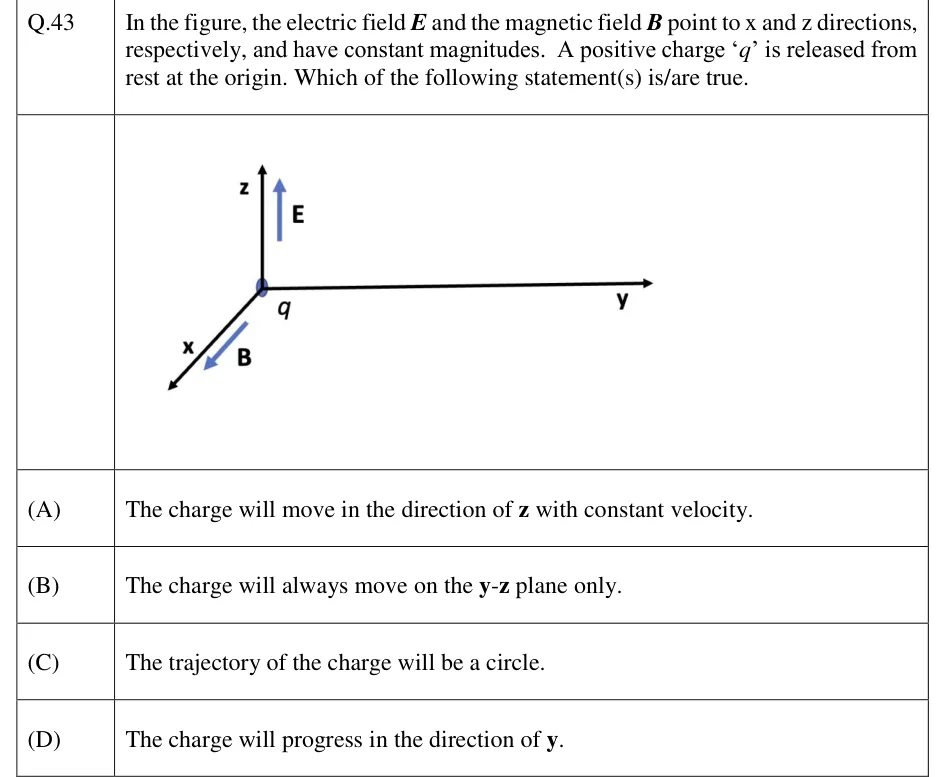
GATE 2023 EE question 43: Right-handed 3D axes with the origin marked by a dot labelled q.Tap to open full size
Figure from the GATE 2023 EE paper. It is part of the question.
Figure description

Right-handed 3D axes with the origin marked by a dot labelled q. The z axis points vertically up, the y axis points horizontally to the right, and the x axis points diagonally down-left, out of the page. A blue arrow labelled E runs parallel to the z axis, pointing up (+z). A blue arrow labelled B runs parallel to the x axis, pointing along +x (down-left). No dimensions are given.

  1. (A)

    The charge will move in the direction of z with constant velocity.

  2. (B)

    The charge will always move on the y-z plane only.

  3. (C)

    The trajectory of the charge will be a circle.

  4. (D)

    The charge will progress in the direction of y.

Answer and solution

ANSWER

Using the fields as drawn (E along +z, B along +x), the charge starts from rest and follows a cycloid that stays in the y-z plane and drifts along +y at E/B. So (B) and (D) are true, and (A) and (C) are false. The official key is MTA.

Official answer: marks to all candidatesSource: Official answer key, GATE 2023 EE (IIT Kanpur)

  1. Set up the fields from the figure. The printed sentence says is along x and along z, but the printed figure draws along +z and along +x. Options (B) and (D) talk about the y-z plane and progress along y, which fit the figure, so we use it: and , both uniform, with .

  2. Lorentz force. . Since , the components are

  3. No motion along x. The charge starts from rest, so , and keeps it at zero. So for all time and the charge stays in the y-z plane. (B) is true.

  4. Solve in the y-z plane. Let (the cyclotron frequency). With : Check: and . Both match the equations above.

  5. Integrate to get the path. This is a cycloid. swings between and , and never decreases because .

  6. Drift. Averaged over one cycle, the velocity is along . That is the direction, since . So the charge progresses along +y. (D) is true.

  7. Rejecting the other options. (A): keeps changing sign and keeps returning to 0, so the velocity along z is not constant. (C): the path is a cycloid. It looks like a circle only from a frame moving at along y, not in the lab frame. (A) and (C) are false.

  8. About the key. The official key is MTA (marks to all). If you use the sentence's assignment instead (, ), the same working keeps the charge in the x-y plane () and gives a drift along , so (B) would fail. With the figure, which the options are written around, the answer is (B) and (D).

KEY IDEA

When uniform E and B fields are at right angles, a charge released from rest feels no force along B, so it stays in the plane perpendicular to B. In that plane it traces a cycloid: its velocity oscillates at the cyclotron frequency on top of a steady drift of speed along .

WATCH OUT FOR

Picking (C) because "a charge in a magnetic field moves in a circle". That is true only with no E field and velocity perpendicular to B. With E present, a charge released from rest follows a cycloid, not a circle. Picking (A) is the opposite mistake: forgetting that the magnetic force turns the motion along E into motion along y, so z keeps coming back to zero. Also, the sentence and the figure give different field directions. Decide which one you are using before you work out the plane of motion and the drift direction.

From the GATE 2023 EE paper. Every question of this paper · Download the full paper · All 12 Magnetostatics questions, with notes

More Magnetostatics questions