
IAE Academy

GATE 2023 EC Q.52: solution and answer

GATE 2023 · ECQ.52 · 2 marks · MSQ

The standing wave ratio on a 50 lossless transmission line terminated in an unknown load impedance is found to be 2.0. The distance between successive voltage minima is 30 cm and the first minimum is located at 10 cm from the load. can be replaced by an equivalent length and terminating resistance of the same line. The value of and , respectively, are
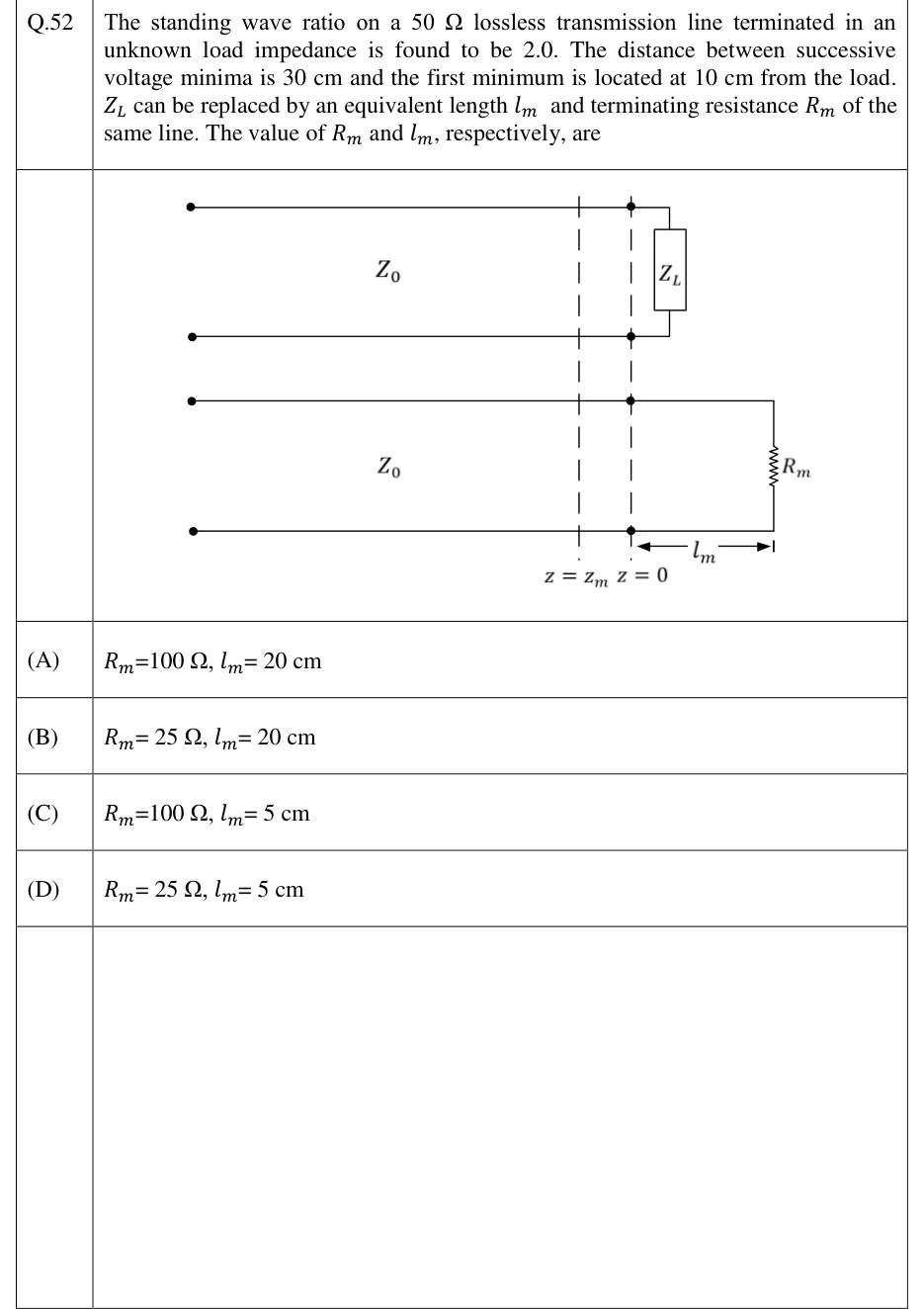
GATE 2023 EC question 52: Two transmission lines, one drawn above the other.Tap to open full size
Figure from the GATE 2023 EC paper. It is part of the question.
Figure description

Two transmission lines, one drawn above the other. Each is a pair of horizontal parallel wires labelled Z_0, with open input terminals (dots) at the left end. Upper line: its wires end at the plane z = 0 (dots on both wires) and are joined there to a box labelled Z_L. Lower line: the same line Z_0 carries on past the plane z = 0 for a further length l_m (a double-headed arrow from z = 0 to the right end, labelled l_m) and ends in a resistor (zigzag symbol) labelled R_m. Two vertical dashed lines cross both lines. The right one is at z = 0, the load plane of the upper line. The left one, a short way towards the input, is labelled z = z_m. The labels z = z_m and z = 0 are printed under the lower line. Not to scale.

  1. (A)

    , cm

  2. (B)

    , cm

  3. (C)

    , cm

  4. (D)

    , cm

Answer and solution

ANSWER

B and C: with cm, or with cm. Both reproduce at the load plane.

Official answer: B, CSource: Official answer key, GATE 2023 EC (IIT Kanpur)

  1. Successive voltage minima are apart, so , which gives and . A voltage maximum sits midway between two minima, from each.

  2. On a lossless line the impedance is purely resistive at the extremes of the standing wave. At a voltage minimum the voltage is smallest and the current largest, so . At a voltage maximum, .

  3. On a lossless line, stays the same everywhere, and the phase of changes steadily with distance. So the impedance at every point is fixed by and the position of one minimum. Carry the same pattern on past the load, as in the lower figure. Minima repeat every , so the real minimum on the generator side of the load has a copy beyond the load. The maximum between these two minima lies beyond the load.

  4. Now end the extended line at either point with the resistance the line shows there. A resistor gives : with a minimum at the resistor. Placed beyond the load, it puts minima beyond the load and before it, which is exactly the measured pattern. A resistor gives : with a maximum at the resistor. Placed beyond the load, it puts the next minimum nearer the generator, at before the load, which is again the measured pattern. The same pattern means the same impedance at , namely . That gives two equivalents: with , and with .

  5. Check by finding directly. . At a voltage minimum , where , so and . Then

  6. The input impedance of a length of line ending in is . For and : and , so For and : and , so Both equal exactly.

  7. Options A and D pair each resistance with the wrong length. at and at both give . Each puts a maximum where the measured pattern has a minimum, or the other way round. The correct options are B and C.

KEY IDEA

On a lossless line the impedance at any point depends only on the SWR and where the minima are. It is purely resistive at the extremes of the standing wave: at a voltage minimum and at a voltage maximum. So any load can be replaced by extending the line to a minimum or a maximum of its own standing-wave pattern and ending it there in that resistance. Because minima repeat every , the minimum 10 cm towards the generator has a copy 20 cm beyond the load, and there is a maximum 5 cm beyond the load.

WATCH OUT FOR

Using the 10 cm distance itself as , or measuring the extension towards the generator instead of past the load. A second trap is pairing with the position of a maximum or with a minimum (options A and D). Both give , not . Finally, this is an MSQ: marking only one of B and C loses the marks, because both equivalents are valid.

From the GATE 2023 EC paper. Every question of this paper · Download the full paper · All 13 Transmission lines questions, with notes

More Transmission lines questions