
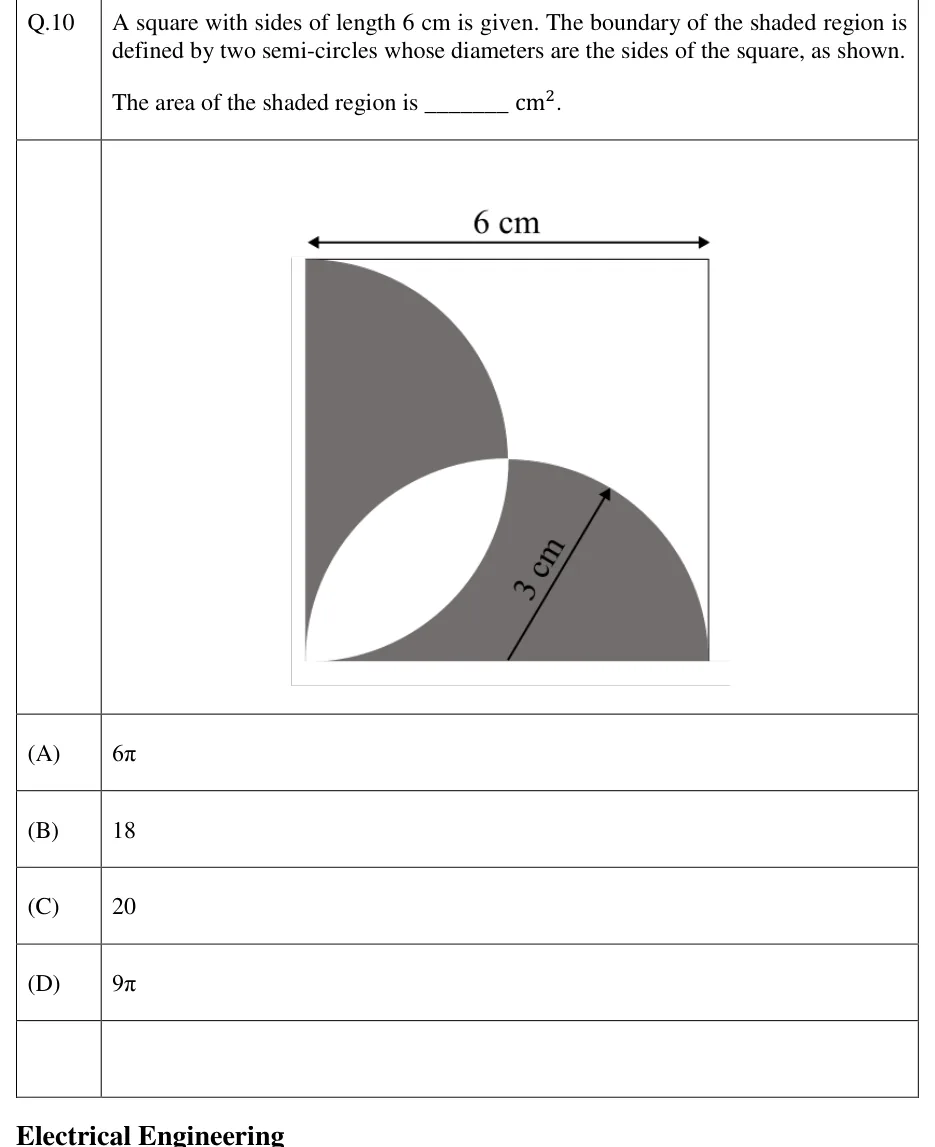
A square with sides of length 6 cm is given. The boundary of the shaded region is defined by two semi-circles whose diameters are the sides of the square, as shown.
The area of the shaded region is ______ .
 Tap to open full size
Figure description
A square of side 6 cm, with a double-headed arrow above its top edge labelled "6 cm". Put the bottom-left corner at the origin, so the square runs from (0,0) to (6,6). Semicircle 1 has the left side of the square, from (0,0) to (0,6), as its diameter. Its centre is (0,3) and its radius is 3. It bulges rightward and just reaches the centre of the square, (3,3). Semicircle 2 has the bottom side, from (0,0) to (6,0), as its diameter. Its centre is (3,0) and its radius is 3. It bulges upward and also just reaches (3,3). The two arcs cross at the bottom-left corner (0,0) and at the centre (3,3). The lens-shaped overlap of the two semicircles, between (0,0) and (3,3), is white (unshaded). The rest of semicircle 1 is shaded dark grey. This upper-left piece includes a thin sliver that runs down along the left side to (0,0). The rest of semicircle 2 is also shaded dark grey. This lower-right piece includes a thin sliver that runs along the bottom side to (0,0). The two shaded pieces touch at (3,3). The part of the square outside both semicircles (upper right) is white. A radius line with an arrowhead runs from the midpoint of the bottom side, (3,0), up and to the right to the arc of semicircle 2. It is labelled "3 cm".
- (A)
- (B)
- (C)
- (D)