IAE Academy

GATE 2023 BT Q.41: solution and answer

GATE 2023 · BTQ.41 · 2 marks · MSQ

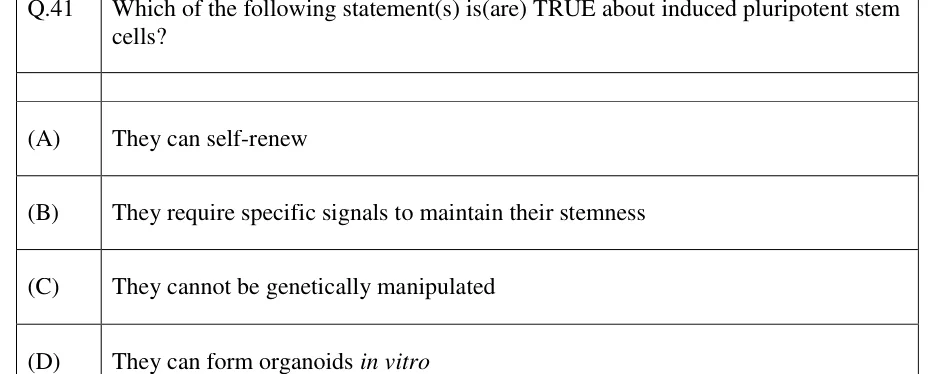
Which of the following statement(s) is(are) TRUE about induced pluripotent stem cells?

  1. (A)

    They can self-renew

  2. (B)

    They require specific signals to maintain their stemness

  3. (C)

    They cannot be genetically manipulated

  4. (D)

    They can form organoids in vitro

See the question in the paper

Answer and solution

ANSWER

The TRUE statements about induced pluripotent stem cells (iPSCs) are: (A) They can self-renew, (B) They require specific signals to maintain their stemness, and (D) They can form organoids in vitro. Statement (C) is FALSE.

Official answer: A, B, DSource: Official answer key, GATE 2023 BT (IIT Kanpur)

  1. Recall that pluripotent stem cells (embryonic stem cells and iPSCs alike) are defined by two coupled properties: pluripotency (ability to give rise to derivatives of all three germ layers) and self-renewal (indefinite division while remaining undifferentiated).

  2. (A) Self-renewal is a core defining property of iPSCs, so this statement is TRUE.

  3. (B) The undifferentiated, self-renewing state of iPSCs is actively maintained, not automatic: culture requires specific signalling inputs (defined growth-factor/cytokine cocktails and supportive niche/matrix conditions). Withdrawing these signals causes spontaneous differentiation, so maintenance of stemness does require specific signals. This statement is TRUE.

  4. (C) iPSCs are themselves produced by a genetic/molecular reprogramming procedure (forced expression of transcription factors such as Oct4, Sox2, Klf4, c-Myc), and established iPSC lines are routinely further genetically engineered (CRISPR editing, reporter knock-ins, correction of mutations). So the claim that they 'cannot be genetically manipulated' is FALSE.

  5. (D) iPSCs are a standard source for generating three-dimensional organoids in culture (e.g., brain, intestinal, kidney, cardiac organoids), so this statement is TRUE.

  6. Collecting the TRUE statements: A, B, and D are true; C is false.

KEY IDEA

Induced pluripotent stem cells (iPSCs) are self-renewing, pluripotent cells generated from somatic cells by forced expression of reprogramming transcription factors. Like other pluripotent stem cells, their undifferentiated, self-renewing state is not a passive default — it must be actively maintained by specific extrinsic signals/culture conditions, and withdrawing these signals triggers spontaneous differentiation. Because iPSCs arise from a genetic reprogramming procedure in the first place, they are inherently amenable to further genetic manipulation (e.g., CRISPR editing, reporter knock-ins, gene correction) and are widely used to derive three-dimensional organoids (e.g., brain, intestinal, kidney, cardiac organoids) in culture.

WATCH OUT FOR

Confusing "genetically manipulated" with "genetically abnormal" or assuming pluripotent cells are somehow protected from manipulation because they are so tightly regulated; in fact iPSCs are created BY genetic manipulation (forced expression of reprogramming factors such as Oct4, Sox2, Klf4, c-Myc) and are routinely further engineered (e.g. CRISPR gene editing, reporter knock-ins), so (C) is clearly false. A second common error is treating "self-renewal" as needing no external input, which would wrongly make (B) look false or contradictory to (A) — self-renewal of pluripotent stem cells is not spontaneous/unconditional; it is actively maintained by specific signalling inputs, so (A) and (B) are both true and not in conflict.

From the GATE 2023 BT paper. Every question of this paper · Download the full paper · All 15 Cell biology questions, with notes

More Cell biology questions