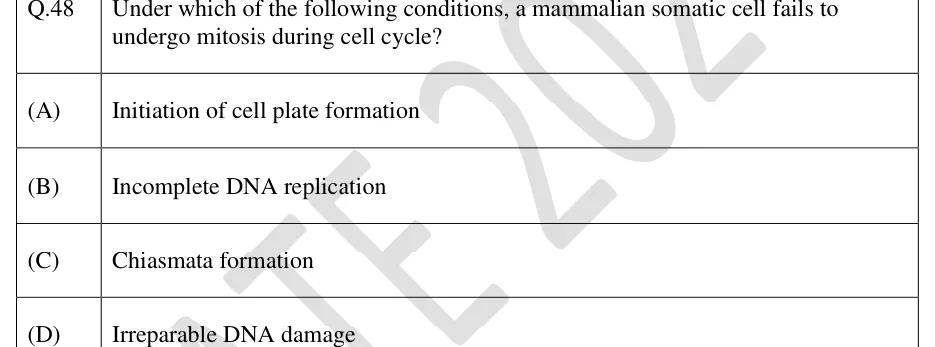
Under which of the following conditions, a mammalian somatic cell fails to undergo mitosis during cell cycle?
- (A)
Initiation of cell plate formation
- (B)
Incomplete DNA replication
- (C)
Chiasmata formation
- (D)
Irreparable DNA damage

Under which of the following conditions, a mammalian somatic cell fails to undergo mitosis during cell cycle?
Initiation of cell plate formation
Incomplete DNA replication
Chiasmata formation
Irreparable DNA damage
ANSWER
GATE BT 2024 Q.48 (MSQ, 2 marks): The mammalian somatic cell cycle fails to proceed into mitosis when (B) DNA replication is incomplete or (D) DNA damage is irreparable — both trigger cell-cycle checkpoint arrest before M-phase. Correct answer: B, D.
Official answer: B, DSource: Official answer key, GATE 2024 BT (IISc Bengaluru)
Read the question: identify the condition(s) under which a mammalian SOMATIC cell fails to undergo MITOSIS during the cell cycle. This is an MSQ, so more than one option may be correct.
Option A — 'Initiation of cell plate formation': cell plate formation is the plant-specific cytokinesis mechanism (built via phragmoplast microtubules and Golgi-derived vesicles at the equatorial plane). Mammalian somatic cells instead complete cytokinesis by cleavage-furrow constriction driven by an actomyosin contractile ring. Since cell plate formation is not even part of mammalian mitotic/cytokinetic biology, it cannot be a cause of mitotic failure in such a cell -> A is incorrect.
Option B — 'Incomplete DNA replication': the cell cycle's G2/M checkpoint (with the intra-S checkpoint, mediated by ATR-Chk1 signalling) monitors completion of genome duplication and blocks activation of the CDK1-cyclin B (M-phase-promoting) complex if replication is incomplete, arresting the cell before mitosis -> B is correct.
Option C — 'Chiasmata formation': chiasmata are the physical sites of crossing-over between homologous chromosomes formed during prophase I of MEIOSIS. Somatic mitotic division has no homolog pairing or synapsis, so chiasmata formation never occurs there and is irrelevant to whether a somatic cell can undergo mitosis -> C is incorrect.
Option D — 'Irreparable DNA damage': the DNA-damage checkpoint (ATM/ATR sensing lesions, signalling via Chk1/Chk2 to p53 and effectors such as p21) arrests the cell cycle before mitosis when damage is detected; when the damage is irreparable, the cell is driven toward senescence or apoptosis instead of being allowed to divide -> D is correct.
Combining the verdicts: the conditions that genuinely cause a mammalian somatic cell to fail to undergo mitosis are incomplete DNA replication and irreparable DNA damage.
Final answer: B and D.
KEY IDEA
The eukaryotic cell cycle has surveillance checkpoints (G1/S, intra-S, G2/M, and the spindle-assembly checkpoint) that halt progression into or through mitosis whenever the genome is not yet safely ready to be segregated — most relevantly here, when DNA replication is not finished (G2/M / replication checkpoint, ATR-Chk1 mediated) or when DNA damage cannot be repaired (DNA-damage checkpoint, ATM/ATR-p53 mediated, often followed by apoptosis or senescence). Conditions that are simply not part of mammalian mitotic biology (plant-specific cell-plate cytokinesis; meiosis-specific chiasmata) are not "conditions that cause mitotic failure" — they are non-sequiturs for a somatic mitotic cell.
WATCH OUT FOR
Confusing cell-cycle checkpoint failures (which block mitosis) with processes that are simply absent or irrelevant in mammalian somatic mitosis — picking (A) by forgetting cell plate formation is a plant-cytokinesis mechanism (not part of animal mitosis at all), or picking (C) by forgetting chiasmata form during meiotic prophase I, not mitosis, so it has no bearing on whether a somatic cell enters or completes mitosis.
From the GATE 2024 BT paper. Every question of this paper · Download the full paper · All 15 Cell biology questions, with notes