IAE Academy

GATE 2022 BT Q.46: solution and answer

GATE 2022 · BTQ.46 · 2 marks · MCQ

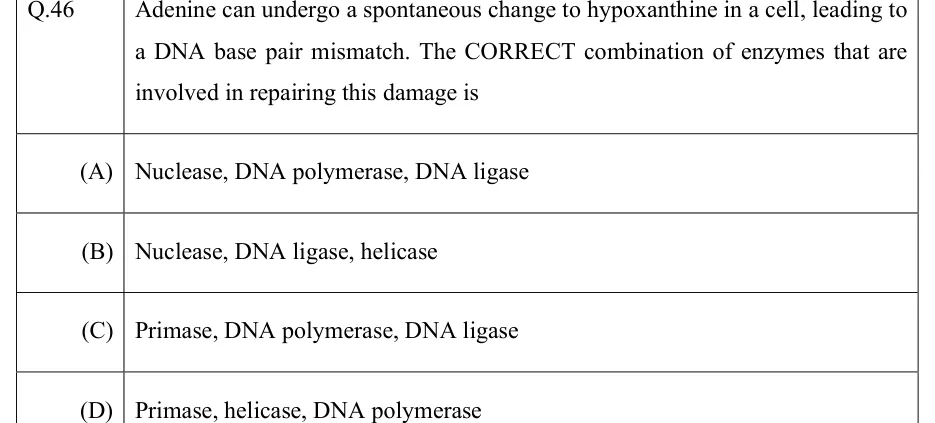
Adenine can undergo a spontaneous change to hypoxanthine in a cell, leading to a DNA base pair mismatch. The CORRECT combination of enzymes that are involved in repairing this damage is

  1. (A)

    Nuclease, DNA polymerase, DNA ligase

  2. (B)

    Nuclease, DNA ligase, helicase

  3. (C)

    Primase, DNA polymerase, DNA ligase

  4. (D)

    Primase, helicase, DNA polymerase

See the question in the paper

Answer and solution

ANSWER

The correct answer is (A) Nuclease, DNA polymerase, DNA ligase.

Official answer: ASource: Official answer key, GATE 2022 BT (IIT Kharagpur)

  1. Adenine can spontaneously deaminate to hypoxanthine, a base not normally found in DNA; hypoxanthine base-pairs like guanine (i.e., with cytosine), so if left unrepaired it directs insertion of C at the next replication, converting the original A:T pair to G:C — a transition mutation. This creates the mismatch the question refers to.

  2. Because this is damage confined to a single base within an otherwise normal duplex, it is repaired by base excision repair (BER) — the pathway dedicated to removing individual damaged or abnormal bases — not by nucleotide excision repair, mismatch repair, or any replication-associated unwinding/priming step.

  3. BER step 1: a DNA glycosylase specific for hypoxanthine/deaminated purines recognizes the lesion and hydrolyzes the N-glycosidic bond, excising the base and leaving an abasic (AP) site. (Note: this step cleaves a base–sugar bond, not a phosphodiester bond, so strictly it is not the 'nuclease' step.)

  4. BER step 2: an AP endonuclease nicks the DNA backbone at the abasic site, and an associated exonuclease/lyase activity removes the abasic sugar-phosphate — this endonucleolytic cutting is the 'nuclease' activity option A refers to.

  5. BER step 3: DNA polymerase (repair polymerase activity, e.g., Pol I-type/Pol β) fills the resulting single-nucleotide gap using the intact complementary strand as template.

  6. BER step 4: DNA ligase seals the remaining nick, restoring an intact phosphodiester backbone.

  7. Helicase (unwinds duplex DNA ahead of a replication fork) and primase (synthesizes RNA primers for new-strand synthesis) are replication enzymes, not required to excise and replace a single damaged base — so options B and D, which include helicase or primase, are wrong.

  8. Option C substitutes primase for the nuclease/endonuclease step, but BER requires excision of the damaged base region (a nuclease-type cut) before gap-filling, not primer synthesis — so C is wrong.

  9. Option A correctly lists the BER enzyme set — nuclease (AP endonuclease, for excision), DNA polymerase (gap filling), and DNA ligase (sealing).

KEY IDEA

Spontaneous deamination of adenine to hypoxanthine (which base-pairs like guanine, i.e. with cytosine) creates a base-pair mismatch that is corrected by base excision repair (BER): a DNA glycosylase excises the aberrant base, an AP endonuclease (a nuclease) nicks the backbone at the resulting abasic site, DNA polymerase fills the single-nucleotide gap, and DNA ligase seals the nick.

WATCH OUT FOR

Confusing this single-base lesion repair with replication machinery: pulling in helicase (unwinds the duplex ahead of a replication fork) or primase (lays down RNA primers for new strand synthesis) as in options B/D, neither of which is needed to excise and replace one damaged base.

From the GATE 2022 BT paper. Every question of this paper · Download the full paper · All 9 Mutation & repair questions, with notes

More Mutation & repair questions