
IAE Academy

GATE 2025 BT Q.40: solution and answer

GATE 2025 · BTQ.40 · 2 marks · MCQ

Correctly match the Enzyme with its respective Function.

Enzyme | Function
P. Gyrase | 1. Removes a damaged base by cleaving the bond between sugar and base
Q. Deadenylase | 2. Provides a swivel allowing one DNA strand to rotate around the other
R. Glycosylase | 3. Catalyses bond formation between 3'-OH and 5'-phosphate end of nucleotides in duplex DNA
S. DNA ligase | 4. Is an exoribonuclease that removes the poly(A) tail
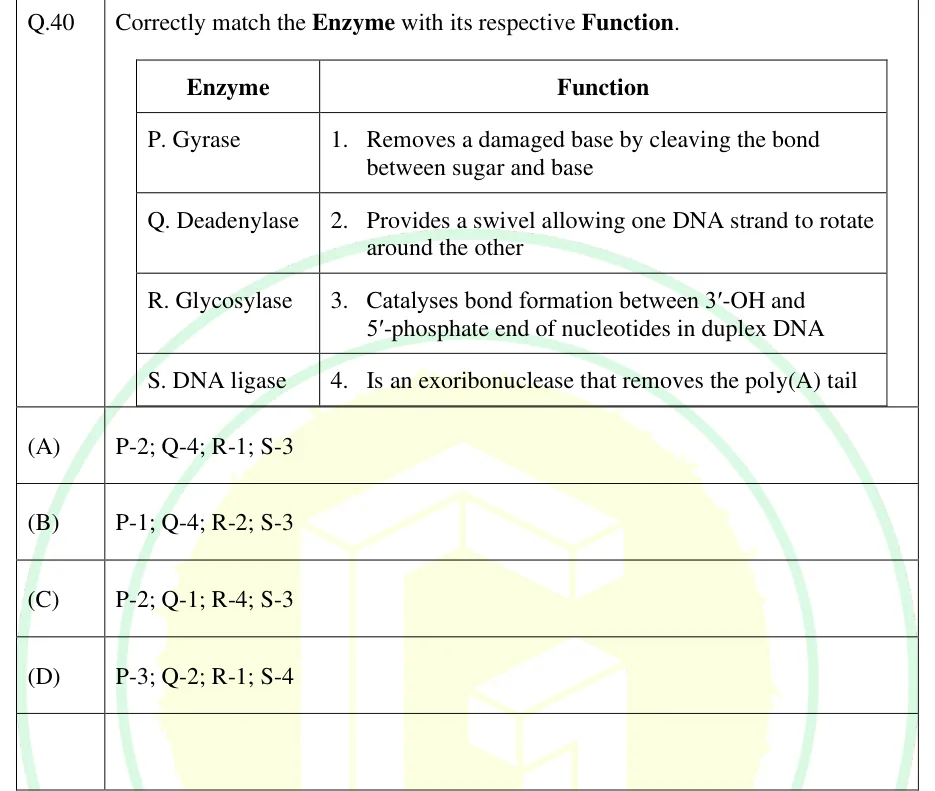
GATE 2025 BT question 40: A two-column table titled 'Enzyme' and 'Function'.Tap to open full size
Figure from the GATE 2025 BT paper. It is part of the question.
Figure description

A two-column table titled 'Enzyme' and 'Function'. Four rows pair a lettered enzyme (P, Q, R, S) with a numbered function description (1, 2, 3, 4) as given in the stem above; no diagram, gel, pedigree or plot is present — it is purely a text-matching table.

  1. (A)

    P-2; Q-4; R-1; S-3

  2. (B)

    P-1; Q-4; R-2; S-3

  3. (C)

    P-2; Q-1; R-4; S-3

  4. (D)

    P-3; Q-2; R-1; S-4

Answer and solution

ANSWER

Option (A) — P-2; Q-4; R-1; S-3 — is correct.

Official answer: ASource: Official answer key, GATE 2025 BT (IIT Roorkee)

  1. P. Gyrase is a bacterial type II topoisomerase whose physiological role during replication/transcription is to act as a swivel, allowing one DNA strand to rotate around the other and relieve torsional (supercoiling) stress ahead of the fork -> matches function 2 (provides a swivel allowing one DNA strand to rotate around the other).

  2. Q. Deadenylase (e.g., in the CCR4-NOT / PAN2-PAN3 complexes) is an exoribonuclease that removes the poly(A) tail from the 3' end of mRNA, the key first step initiating mRNA decay -> matches function 4 (exoribonuclease that removes the poly(A) tail).

  3. R. Glycosylase is the base-excision-repair enzyme that recognizes a damaged or inappropriate base and cleaves the N-glycosidic bond between that base and its deoxyribose sugar, creating an AP site, without removing the sugar-phosphate backbone -> matches function 1 (removes a damaged base by cleaving the bond between sugar and base).

  4. S. DNA ligase catalyses formation of a phosphodiester bond between a 3'-OH and a 5'-phosphate end of adjacent nucleotides in duplex DNA, sealing nicks (e.g., after Okazaki fragment processing or repair synthesis) -> matches function 3 (catalyses bond formation between 3'-OH and 5'-phosphate end of nucleotides in duplex DNA).

  5. Combining all four matches: P-2; Q-4; R-1; S-3.

  6. Comparing with the options: this exactly matches option (A) P-2; Q-4; R-1; S-3.

KEY IDEA

Match each DNA/RNA-processing enzyme to its precise molecular function: gyrase relieves torsional strain by acting as a swivel, deadenylase is an exoribonuclease that removes the mRNA poly(A) tail, glycosylase excises a damaged base in base-excision repair, and DNA ligase seals nicks by joining a 3'-OH to a 5'-phosphate.

WATCH OUT FOR

Confusing glycosylase (removes only the damaged base, leaving an abasic site) with an endonuclease/exonuclease that removes nucleotides, or confusing gyrase's swivel/supercoiling-relief role with helicase's strand-unwinding role.

From the GATE 2025 BT paper. Every question of this paper · Download the full paper · All 9 Mutation & repair questions, with notes

More Mutation & repair questions