IAE Academy

GATE 2024 DA Q.22: solution and answer

GATE 2024 · DAQ.22 · 1 mark · MCQ

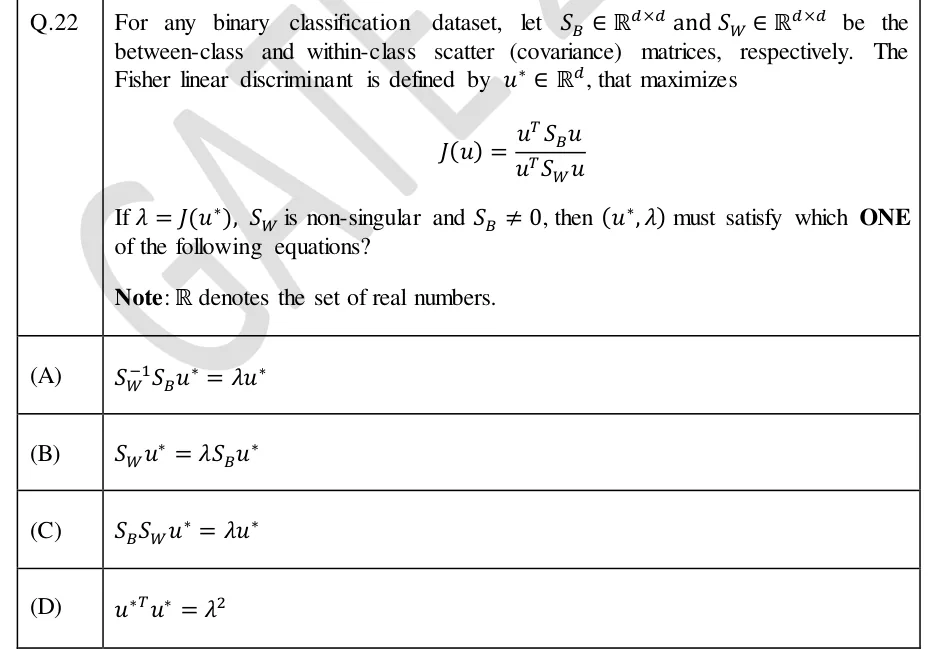
For any binary classification dataset, let and be the between-class and within-class scatter (covariance) matrices, respectively. The Fisher linear discriminant is defined by , that maximizes

If , is non-singular and , then must satisfy which ONE of the following equations?

Note: denotes the set of real numbers.

  1. (A)

  2. (B)

  3. (C)

  4. (D)

See the question in the paper

Answer and solution

ANSWER

The pair must satisfy , which is option (A).

Official answer: ASource: Official answer key, GATE 2024 DA (IISc Bengaluru)

  1. is a ratio of quadratic forms (a Rayleigh quotient) and is unchanged when is scaled. At the maximiser the gradient must vanish: .

  2. Differentiate with the quotient rule, using that and are symmetric:

  3. Set this to zero at and divide by , which is positive because is a non-singular scatter matrix (positive definite) and :

  4. This is the generalised eigenvalue problem , where is the maximum value of the quotient. Since is positive semi-definite, some gives , so .

  5. Since is non-singular, multiply on the left by : So is the eigenvector of belonging to its largest eigenvalue . This is option (A).

  6. Check the others. (B) has and swapped: would mean , which contradicts step 3 unless . (C) has the matrices in the wrong order and no inverse, so it does not follow. (D) is not implied, because can be scaled freely without changing , so is not fixed by . Only (A) must hold.

KEY IDEA

Maximising the ratio gives the generalised eigenproblem . With invertible this becomes the ordinary eigenproblem for , and the maximum is its largest eigenvalue.

WATCH OUT FOR

Swapping the matrices and writing , or multiplying in the wrong order (). The inverse must multiply from the left, so that it comes from .

From the GATE 2024 DA paper. Every question of this paper · Download the full paper · All 7 LDA, SVM & trees questions, with notes

More LDA, SVM & trees questions