IAE Academy

GATE 2026 DA Q.23: solution and answer

GATE 2026 · DAQ.23 · 1 mark · MSQ

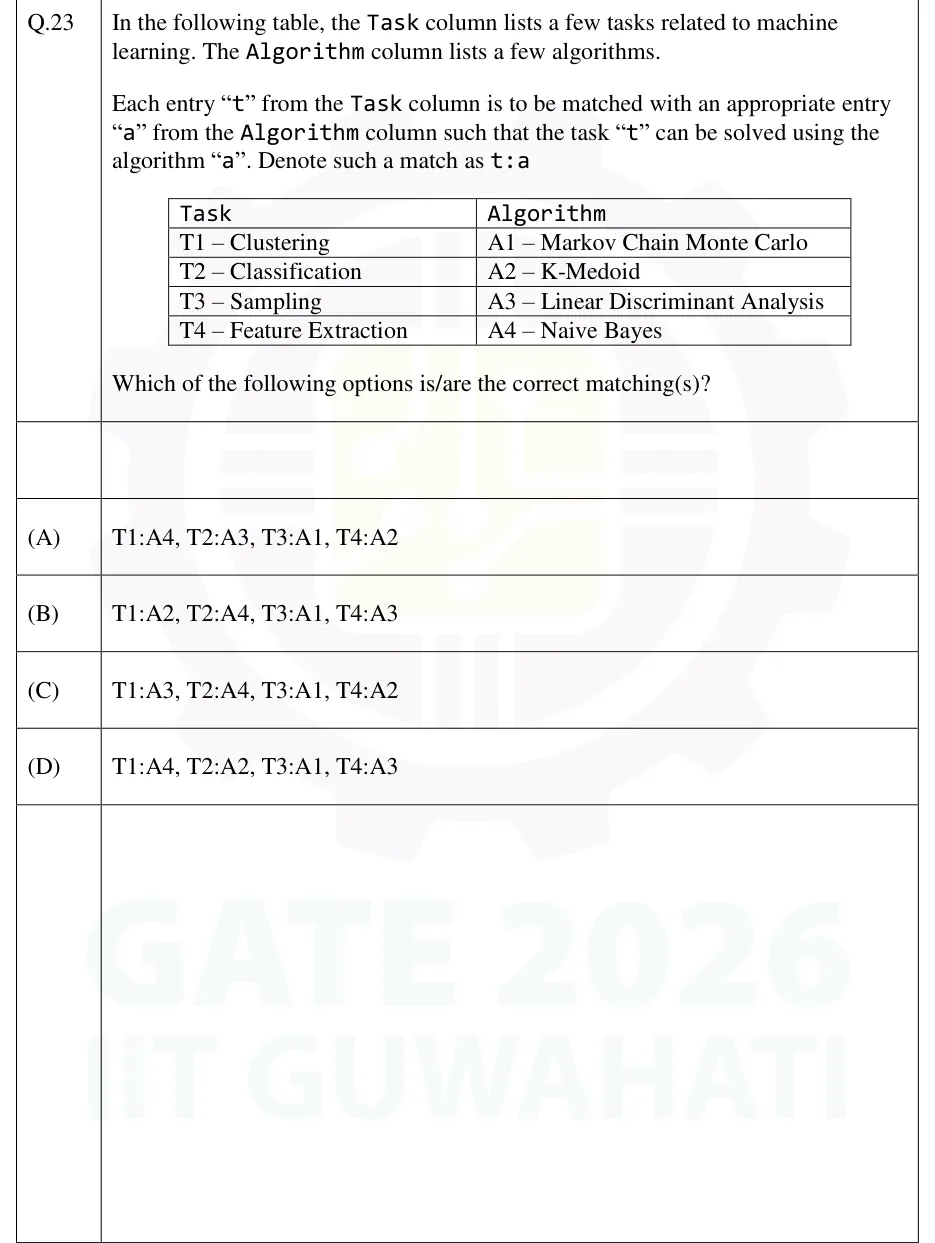
In the following table, the Task column lists a few tasks related to machine learning. The Algorithm column lists a few algorithms.

Each entry "t" from the Task column is to be matched with an appropriate entry "a" from the Algorithm column such that the task "t" can be solved using the algorithm "a". Denote such a match as t:a.

| Task | Algorithm |
|---|---|
| T1 – Clustering | A1 – Markov Chain Monte Carlo |
| T2 – Classification | A2 – K-Medoid |
| T3 – Sampling | A3 – Linear Discriminant Analysis |
| T4 – Feature Extraction | A4 – Naive Bayes |

Which of the following options is/are the correct matching(s)?

  1. (A)

    T1:A4, T2:A3, T3:A1, T4:A2

  2. (B)

    T1:A2, T2:A4, T3:A1, T4:A3

  3. (C)

    T1:A3, T2:A4, T3:A1, T4:A2

  4. (D)

    T1:A4, T2:A2, T3:A1, T4:A3

See the question in the paper

Answer and solution

ANSWER

The correct matching is T1:A2, T2:A4, T3:A1, T4:A3, which is option (B).

Official answer: BSource: Official answer key, GATE 2026 DA (IIT Guwahati)

  1. Each task must be paired with an algorithm that can actually solve it. Fix T1 first, because it is the task that separates the four options.

  2. T1, Clustering: K-Medoid partitions unlabelled points into clusters around representative points (medoids). So T1:A2. Naive Bayes and Linear Discriminant Analysis need class labels, so they are supervised and are not clustering methods. Markov Chain Monte Carlo is a sampling method, not a clustering method.

  3. T2, Classification: Naive Bayes is a generative classifier. It applies Bayes' theorem with a conditional-independence assumption on the features, so T2:A4.

  4. T3, Sampling: Markov Chain Monte Carlo builds a Markov chain whose stationary distribution is the target distribution, then draws samples from it. So T3:A1.

  5. T4, Feature Extraction: Linear Discriminant Analysis projects the data onto directions that maximise between-class scatter relative to within-class scatter. The projections form a reduced set of new features, so T4:A3.

  6. The full matching is T1:A2, T2:A4, T3:A1, T4:A3.

  7. Compare with the options. (A) has T1:A4 and (D) has T1:A4, but Naive Bayes is a supervised classifier and cannot cluster. (C) has T1:A3, but Linear Discriminant Analysis is also supervised. Option (D) also has T2:A2, but K-Medoid is a clustering algorithm. Only (B) gives the full matching above.

KEY IDEA

Match each task to the algorithm built for it. Clustering goes with K-Medoid, classification with Naive Bayes, sampling with Markov Chain Monte Carlo, and feature extraction with Linear Discriminant Analysis, which projects onto class-separating directions. Clustering is the quickest way to eliminate the wrong options.

WATCH OUT FOR

Pairing clustering with a supervised method such as Naive Bayes or Linear Discriminant Analysis, or pairing Linear Discriminant Analysis with classification only and forgetting its use as a feature-extraction (dimensionality-reduction) step. It can also be used to classify, but that does not make T1:A3 or T1:A4 valid.

From the GATE 2026 DA paper. Every question of this paper · Download the full paper · All 7 LDA, SVM & trees questions, with notes

More LDA, SVM & trees questions