
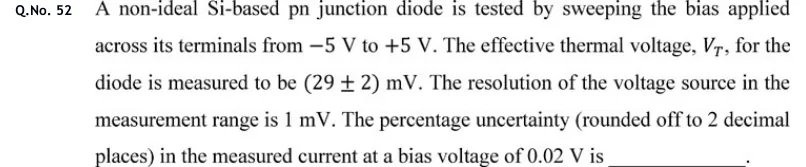
A non-ideal Si-based pn junction diode is tested by sweeping the bias applied across its terminals from to . The effective thermal voltage, , for the diode is measured to be . The resolution of the voltage source in the measurement range is . The percentage uncertainty (rounded off to 2 decimal places) in the measured current at a bias voltage of is ________.
GATE 2020 EE Q.52: solution and answer
Answer and solution
ANSWER
At a bias of , the percentage uncertainty in the measured diode current is about .
Official answer: 11.50 to 12.00Source: Official answer key, GATE 2020 EE (IIT Delhi)
Use the full diode equation. The effective thermal voltage already includes the ideality factor, so The saturation current is not given with an uncertainty, so it is treated as exact. The only uncertain quantities are the bias and the thermal voltage .
Data: , (the resolution of the source), , .
You cannot drop the here. The shortcut only works when . At this bias The exponential is only about twice the , so the roughly halves the current and has to be kept.
Partial derivatives: Divide each by . Both relative sensitivities then carry the same factor
Relative uncertainty in due to :
Relative uncertainty in due to :
(set by the source) and (a property of the diode) are measured independently, so the two contributions add as a root-sum-square:
The percentage uncertainty in the measured current is .
KEY IDEA
Propagate the uncertainty through the full diode law . At the bias is smaller than , so the term matters. It multiplies both relative sensitivities by . The independent contributions from and then combine as a root-sum-square.
WATCH OUT FOR
The usual mistake is to use , which is only valid for . At it gives (root-sum-square) or (linear sum), both far from the key. Two other slips: adding the two contributions linearly with the full equation gives , and taking half the source resolution () as gives .
From the GATE 2020 EE paper. Every question of this paper · Download the full paper · All 11 Errors & standards questions, with notes
More Errors & standards questions
- GATE 2018 IN Q.47 · NAT · 2 marksThe voltage and current drawn by a resistive load are measured with a 300 V voltmeter of accuracy ± 1% of…
- GATE 2026 IN Q.29 · MSQ · 1 markIn a linear element, the measured current is 100 mA ± 2.5% and the measured voltage is 5 V ± 5%.
- GATE 2026 IN Q.49 · MCQ · 2 marksIf the definition of SI unit 'X' is required to define SI unit 'Y', the dependency is indicated as X → Y.
- GATE 2025 EE Q.31 · NAT · 1 markThe maximum percentage error in the equivalent resistance of two parallel-connected resistors of 100 Ω and…