
IAE Academy

GATE 2018 EC Q.35: solution and answer

GATE 2018 · ECQ.35 · 2 marks · MCQ

For the circuit given in the figure, the voltage (in volts) across the capacitor is
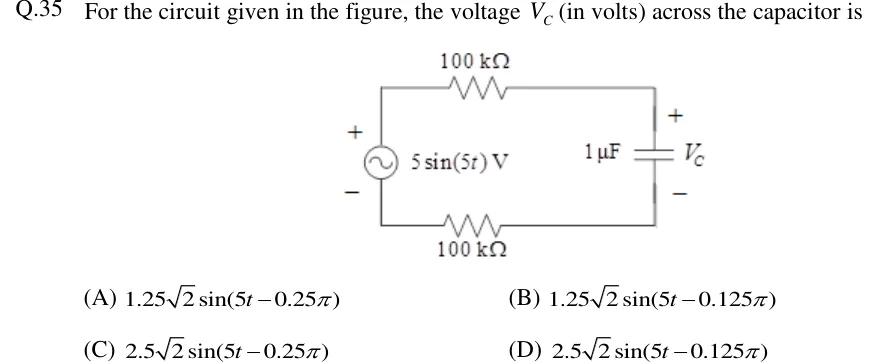
GATE 2018 EC question 35: A single series loop.Tap to open full size
Figure from the GATE 2018 EC paper. It is part of the question.
Figure description

A single series loop. On the left is an AC voltage source 5 sin (5t) V, drawn with + at the top and − at the bottom. From the source's top terminal a wire runs through a 100 k Ω resistor along the top edge to the right-hand side. On the right-hand side is a 1 capacitor whose voltage V_C is marked + at its top plate and − at its bottom plate. From the capacitor's bottom plate a wire runs back through a second 100 k Ω resistor along the bottom edge to the source's bottom (−) terminal. So source, top resistor, capacitor and bottom resistor are all in series, and the source + and capacitor + are both on the top rail.

  1. (A)

  2. (B)

  3. (C)

  4. (D)

Answer and solution

ANSWER

, option (C).

Official answer: CSource: Official answer key, GATE 2018 EC (IIT Guwahati)

  1. Combine the series resistors: there is only one loop, so both resistors carry the same current as the capacitor. The one on the return wire counts just as much as the one on top. Together they act as in series with the capacitor.

  2. Capacitor impedance at : .

  3. Source phasor: take as the phase reference. The options are written as amplitudes, so we work with peak phasors: (peak).

  4. Voltage divider: the source's + terminal and the capacitor's + plate are both on the top rail, so the divider applies with no sign change:

  5. The key product: , so

  6. Back to the time domain: and . So : the capacitor voltage lags the source by . This is option (C).

KEY IDEA

This is a series RC voltage divider. Both resistors sit in the one loop, so they add to no matter where they are drawn. With the divider ratio becomes : the amplitude drops by and the phase lags by .

WATCH OUT FOR

(1) Leaving out the resistor on the bottom return wire. That uses , so , giving about , which is not among the options. (2) Converting to rms and then dividing by a second time. The rms value of is ; dividing again gives , which is the magnitude in options (A)/(B). (3) Halving the phase to , or using when the in is already in rad/s.

From the GATE 2018 EC paper. Every question of this paper · Download the full paper · All 34 AC, power & resonance questions, with notes

More AC, power & resonance questions