
IAE Academy

GATE 2022 EE Q.28: solution and answer

GATE 2022 · EEQ.28 · 1 mark · NAT

The network shown below has a resonant frequency of 150 kHz and a bandwidth of 600 Hz. The -factor of the network is ________. (round off to nearest integer)
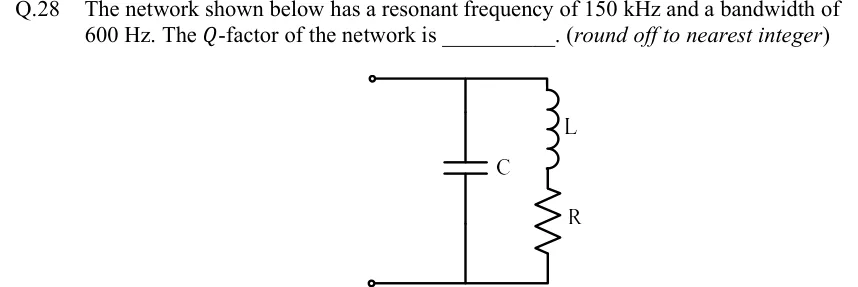
GATE 2022 EE question 28: A two-terminal network with input terminals at top-left and bottom-left (open circles).Tap to open full size
Figure from the GATE 2022 EE paper. It is part of the question.
Figure description

A two-terminal network with input terminals at top-left and bottom-left (open circles). The top rail runs from the top terminal to the right; the bottom rail runs from the bottom terminal to the right. Between the rails there are two parallel branches: (1) a capacitor C connected directly from the top rail to the bottom rail; (2) to its right, a series branch of an inductor L (upper) followed by a resistor R (lower), connected from the top rail to the bottom rail. So the network is C in parallel with the series combination of L and R (a practical parallel tank circuit). No numerical element values are given.

Answer and solution

ANSWER

The Q-factor of the network is 250.

Official answer: 250Source: Official answer key, GATE 2022 EE (IIT Kharagpur)

  1. Identify the network. This is a practical parallel (tank) resonant circuit: in parallel with the series branch –. No element values are given, and we do not need them.

  2. Quality factor from the frequency response. For a resonant network, where is the resonant frequency and BW is the half-power () bandwidth. Both are given, so this is the definition to use.

  3. Put both quantities in the same unit: and .

  4. Compute:

  5. Result: . It is already a whole number, so rounding to the nearest integer changes nothing. (Check: , so this is a sharply tuned, narrow-band circuit. For a tank circuit the element-based and then agree closely.)

KEY IDEA

For any resonant network, Q = f_0 / BW, where BW is the half-power bandwidth. When f_0 and BW are given, you get Q straight from them. You don't need the element values or the circuit topology (series, parallel or tank).

WATCH OUT FOR

Mixing units: dividing 150 by 600 (kHz over Hz) gives 0.25 instead of 250. A second mistake is to multiply or divide by 2π when one quantity is in rad/s and the other in Hz. Here both are in Hz, so no 2π appears. A third is to try to find Q as ω_0 L / R or R√(C/L). That can't be done without element values and isn't needed.

From the GATE 2022 EE paper. Every question of this paper · Download the full paper · All 34 AC, power & resonance questions, with notes

More AC, power & resonance questions