
IAE Academy

GATE 2020 EC Q.28: solution and answer

GATE 2020 · ECQ.28 · 2 marks · MCQ

The current I in the given network is
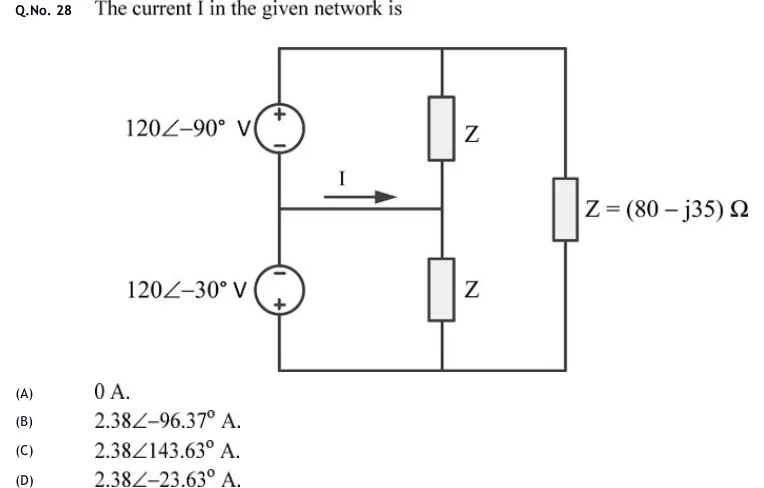
GATE 2020 EC question 28: Three vertical branches connected between a top rail T and a bottom rail B.Tap to open full size
Figure from the GATE 2020 EC paper. It is part of the question.
Figure description

Three vertical branches connected between a top rail T and a bottom rail B. LEFT branch: two ideal AC voltage sources in series on the left vertical wire, with a mid-node M between them. The upper source is labelled 120∠−90° V, with + at the top (at T) and − at the bottom (at M). The lower source is labelled 120∠−30° V, with − at the top (at M) and + at the bottom (at B). MIDDLE branch: two impedances in series from T to B, each labelled Z. Their junction J is joined to M by a horizontal wire carrying current I, arrow pointing right (from M to J). RIGHT branch: one impedance from T to B labelled Z = (80 − j35) Ω, which gives the value of Z used for all three impedances.

  1. (A)

    0 A.

  2. (B)

    2.38∠−96.37° A.

  3. (C)

    2.38∠143.63° A.

  4. (D)

    2.38∠−23.63° A.

Answer and solution

ANSWER

I = 2.38∠143.63° A, which is option (C).

Official answer: CSource: Official answer key, GATE 2020 EC (IIT Delhi)

  1. Reference and node voltages. The wire carrying joins and directly, so they are the same node. Take . The upper source has + at and − at , so . The lower source has − at and + at , so .

  2. Currents in the two middle impedances (Ohm's law). Take downward as positive. Upper (from to ): . Lower (from to ): .

  3. KCL at node J. Two currents enter : from the wire and from above. One current leaves: downward. So , which gives The right-hand impedance is connected directly across –, and the two series sources fix that voltage. Its current flows around the source loop and never enters node , so it does not appear in this KCL.

  4. Phasor sum. . With the minus sign, the numerator is .

  5. Impedance in polar form. .

  6. Divide. In rectangular form this is .

  7. Match to the options. , which is option (C).

KEY IDEA

The wire carrying I puts M and J at the same potential. Take that node as the reference. The two sources then fix V_T = 120∠−90° V and V_B = +120∠−30° V directly, and KCL at J involves only the two middle impedances, giving I = −(V_T + V_B)/Z. The right-hand Z sits straight across the sources and never touches node J, so it does not enter the calculation for I.

WATCH OUT FOR

Misreading the lower source's polarity. Its + terminal is at the bottom, so V_B = +120∠−30° relative to M, and the two phasors ADD in the numerator. Getting that sign wrong gives the wrong magnitude. A second trap is option (A): treating the two identical Z's as a balanced divider and concluding no current flows in the M–J wire. That would need V_T = −V_B, and the phase difference between the sources rules it out. A third mistake is adding the angles of the numerator and Z instead of subtracting them when dividing phasors.

From the GATE 2020 EC paper. Every question of this paper · Download the full paper · All 34 AC, power & resonance questions, with notes

More AC, power & resonance questions