
IAE Academy

GATE 2020 EE Q.18: solution and answer

GATE 2020 · EEQ.18 · 1 mark · NAT

Currents through ammeters A2 and A3 in the figure are and , respectively. The reading of the ammeter A1 (rounded off to 3 decimal places) is ______ A.
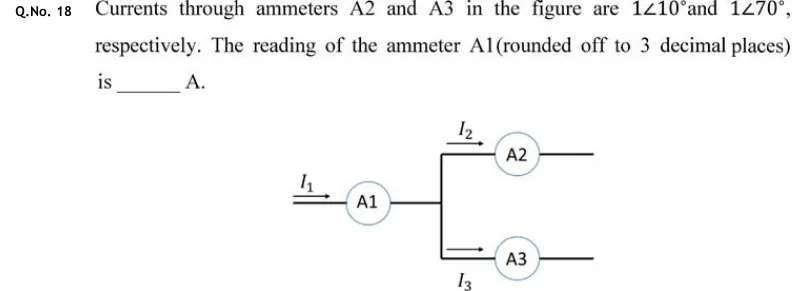
GATE 2020 EE question 18: A single wire carries current I_1 (arrow pointing right) into ammeter A1.Tap to open full size
Figure from the GATE 2020 EE paper. It is part of the question.
Figure description

A single wire carries current I_1 (arrow pointing right) into ammeter A1. The wire leaving A1 goes to a junction node on a vertical conductor. The vertical conductor splits into two horizontal branches. The upper branch carries current I_2 (arrow pointing right) through ammeter A2 and continues to the right, open-ended. The lower branch carries current I_3 (arrow pointing right) through ammeter A3 and continues to the right, open-ended. No other elements are shown, so A1 measures the total current, which then divides between the A2 and A3 branches.

Answer and solution

ANSWER

The ammeter A1 reads (the phasor current is ).

Official answer: 1.700 to 1.750Source: Official answer key, GATE 2020 EE (IIT Delhi)

  1. KCL at the junction: the current through A1 is the phasor sum of the two branch currents, .

  2. Magnitude of the sum of two phasors: , so . Equivalently, for two equal magnitudes, , and the resultant lies on the bisector, at .

  3. Check in rectangular form: , , so .

  4. An ammeter reads only the magnitude of the current, not its phase, so A1 reads .

KEY IDEA

In AC circuits KCL holds for phasors, not for meter readings. The current through A1 is the vector sum . The two currents are apart, so the sum has magnitude .

WATCH OUT FOR

Adding the ammeter readings as plain numbers () ignores the phase difference between the branch currents. Another slip is to use the difference directly in instead of the half-angle, which gives . The correct result is .

From the GATE 2020 EE paper. Every question of this paper · Download the full paper · All 34 AC, power & resonance questions, with notes

More AC, power & resonance questions