IAE Academy

GATE 2020 EE Q.32: solution and answer

GATE 2020 · EEQ.32 · 2 marks · MCQ

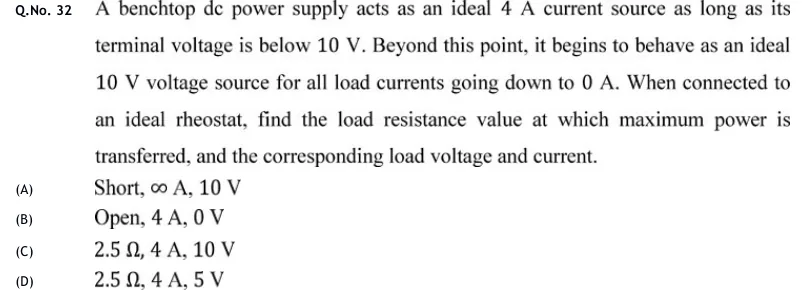
A benchtop dc power supply acts as an ideal 4 A current source as long as its terminal voltage is below 10 V. Beyond this point, it begins to behave as an ideal 10 V voltage source for all load currents going down to 0 A. When connected to an ideal rheostat, find the load resistance value at which maximum power is transferred, and the corresponding load voltage and current.

  1. (A)

    Short, A, 10 V

  2. (B)

    Open, 4 A, 0 V

  3. (C)

    2.5 , 4 A, 10 V

  4. (D)

    2.5 , 4 A, 5 V

See the question in the paper

Answer and solution

ANSWER

The rheostat should be set to 2.5 Ω, where the load current is 4 A and the load voltage is 10 V, giving a maximum of 40 W. The answer is (C).

Official answer: CSource: Official answer key, GATE 2020 EE (IIT Delhi)

  1. Supply characteristic. For the supply is an ideal current source, . For it is an ideal voltage source, . The two pieces meet at the corner .

  2. Corner load (Ohm's law). The load line passes through that corner when

  3. Current-source region, . Here , so the supply holds and Power rises with and reaches at .

  4. Voltage-source region, . Here , so the supply holds and Power falls as increases, starting from at .

  5. Maximum. rises up to and falls beyond it, and both expressions give at the corner. So maximum power is delivered at , where , and .

  6. Checking the other options. A short makes and an open makes , so both deliver zero power. Option (A) is also impossible as printed, because the supply limits its current to and a short cannot hold . Option (D) pairs and with , which breaks Ohm's law, since . The answer is (C).

KEY IDEA

This supply has no linear Thevenin equivalent. It is current-limited below 10 V and voltage-limited up to 4 A, so the rule does not apply. Delivered power rises along the current-limited branch () and falls along the voltage-limited branch (), so the maximum is at the knee of the V–I characteristic, , which the load reaches when .

WATCH OUT FOR

Applying the linear maximum-power-transfer rule . An ideal current source has , which suggests an open load, and an ideal voltage source has , which suggests a short. Both loads deliver zero power here. A second trap is the matched-load habit of taking half the source voltage (5 V), which gives option (D). But 4 A through 2.5 Ω is 10 V, not 5 V, so (D) breaks Ohm's law.

From the GATE 2020 EE paper. Every question of this paper · Download the full paper · All 25 Laws & node/mesh questions, with notes

More Laws & node/mesh questions