
IAE Academy

GATE 2018 EC Q.53: solution and answer

GATE 2018 · ECQ.53 · 2 marks · NAT

Consider the network shown below with , and . The network is connected to a constant voltage source of 11V.

The magnitude of the current (in amperes, accurate to two decimal places) through the source is ______.
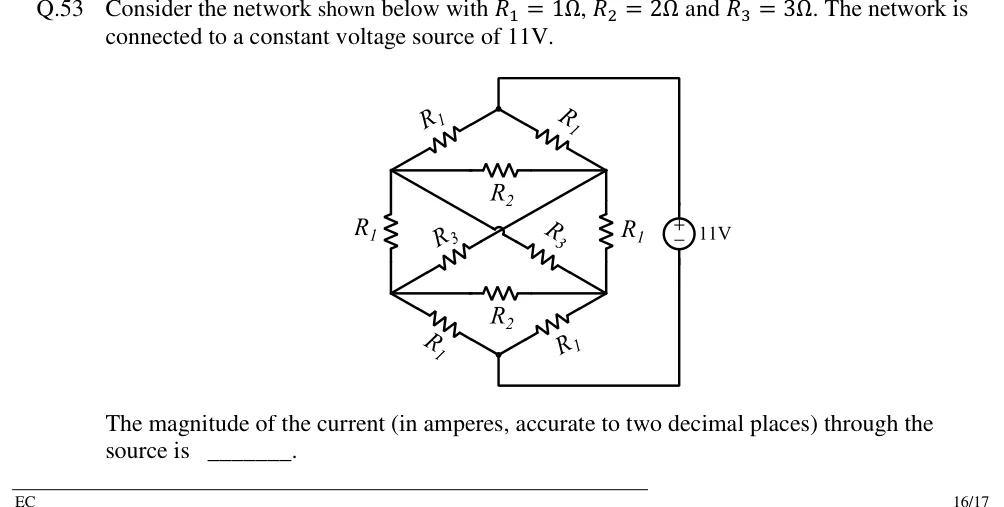
GATE 2018 EC question 53: A hexagon-shaped resistor network with six nodes: top apex A, upper-left C, upper-right D, lower-left E, lower-right F…Tap to open full size
Figure from the GATE 2018 EC paper. It is part of the question.
Figure description

A hexagon-shaped resistor network with six nodes: top apex A, upper-left C, upper-right D, lower-left E, lower-right F, bottom apex B. Branches: A–C is R_1, A–D is R_1; C–D is a horizontal R_2; C–E is the left vertical R_1; D–F is the right vertical R_1; E–F is a horizontal R_2; E–B is R_1, F–B is R_1. Two diagonals: C to F with an R_3 drawn on the half nearer F, and D to E with an R_3 drawn on the half nearer E. The diagonals cross at the centre and no junction dot is drawn there (the answer is the same either way). An 11 V DC source stands to the right of the network: its + terminal is wired to the top apex A and its − terminal to the bottom apex B.

Answer and solution

ANSWER

The current through the source is 8.00 A. The network reduces to across the 11 V source.

Official answer: 7.9 to 8.1Source: Official answer key, GATE 2018 EC (IIT Guwahati)

  1. Symmetry. The network is its own mirror image about the vertical line through and , and the source is connected across and . So and .

  2. Branches with no current. Each joins two nodes at the same potential (– and –), so each carries zero current and can be removed. Equipotential nodes can also be merged: call node and node .

  3. The diagonals. Each runs from the upper pair to the lower pair ( to and to ), so after merging, both sit between and . It makes no difference whether the crossing is a junction. The upper half of each diagonal is plain wire, so the crossing point on the – diagonal is at and the one on the – diagonal is at . These are equal, so joining them changes nothing.

  4. Series–parallel reduction. Between and : . Between and : . Between and : .

  5. Equivalent resistance.

  6. Source current (Ohm's law). Check: and . The – drop is , which agrees.

KEY IDEA

The network is mirror-symmetric about the line through the two source terminals, so the mirror-image nodes are equipotential. The two bridges then carry no current and can be removed, and the symmetric node pairs can be merged. After that, the network is a plain series–parallel chain: .

WATCH OUT FOR

One mistake is to treat the crossing diagonals as a single junction that splits the resistors differently. Another is to keep the bridges in the calculation and try a full nodal analysis. Both carry zero current by symmetry, and the crossing point is at the upper-pair potential whether or not it is joined, so . A further slip is combining as or as instead of .

From the GATE 2018 EC paper. Every question of this paper · Download the full paper · All 25 Laws & node/mesh questions, with notes

More Laws & node/mesh questions