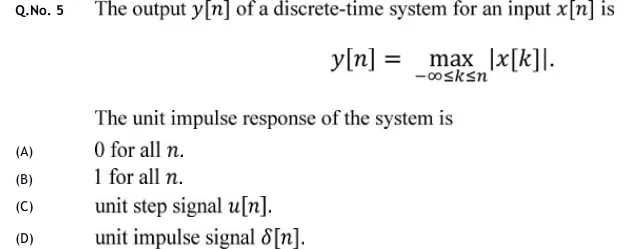
The output of a discrete-time system for an input is
The unit impulse response of the system is
- (A)
0 for all .
- (B)
1 for all .
- (C)
unit step signal .
- (D)
unit impulse signal .

The output of a discrete-time system for an input is
The unit impulse response of the system is
0 for all .
1 for all .
unit step signal .
unit impulse signal .
ANSWER
The unit impulse response is the unit step signal : the running maximum of is for and for all . Option (C).
Official answer: CSource: Official answer key, GATE 2020 EC (IIT Delhi)
By definition, the impulse response is the output when the input is . Here equals at and at every other .
For : the window never reaches , so every in it is . Hence .
For : the window now contains , where , and every other sample in it is . Hence .
Combining the two cases:
Checking the other options: (A) is wrong because from onwards the window contains the sample of value . (B) is wrong because for that sample is not yet in the window. (D) is wrong because a running maximum can never decrease: once it has seen the at , it stays at for every and does not fall back to at .
Note: the system is non-linear (because of and ), so does not fully describe it and cannot be used in a convolution. The question only asks for the output when the input is , and that output is .
KEY IDEA
is a running maximum of over all past and present samples, so it can only stay the same or rise. With , the single sample of value at enters the window at and stays in it for every later . The output jumps from to at and holds there, which is .
WATCH OUT FOR
Choosing (D), , by treating the system as if it passed the current input straight through. The maximum is taken over the whole past window , not only , so the at is remembered for all . A second mistake is to use this in a convolution: the system is non-linear, so does not determine its response to other inputs.
From the GATE 2020 EC paper. Every question of this paper · Download the full paper · All 31 LTI & convolution questions, with notes