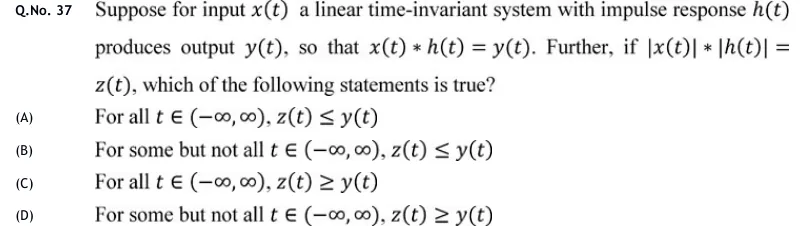
Suppose for input a linear time-invariant system with impulse response produces output , so that . Further, if , which of the following statements is true?
- (A)
For all ,
- (B)
For some but not all ,
- (C)
For all ,
- (D)
For some but not all ,

Suppose for input a linear time-invariant system with impulse response produces output , so that . Further, if , which of the following statements is true?
For all ,
For some but not all ,
For all ,
For some but not all ,
ANSWER
(C): for all , , because at every instant.
Official answer: CSource: Official answer key, GATE 2020 EE (IIT Delhi)
The question compares and with and , so the signals are real-valued. Write both outputs as convolution integrals:
For every , . The magnitude of an integral is at most the integral of the magnitude (the triangle inequality for integrals), so
A real number is never larger than its magnitude, so . Combining this with step 2: No condition on or was used, so for all , for every input and every impulse response. This is option (C).
(D) says holds for some but NOT all . Step 3 shows it holds at every , so the 'not all' part is never true and (D) is always false.
(A) is not always true. Take and . For , and both are zero for . So and . At , , so fails and (A) is false.
(B) is not always true either. Take . Both signals are non-negative, so and , giving . Then holds at EVERY (with equality), so 'some but not all' is false. (B) does happen to hold for the pair in step 5, which is why one example cannot settle this. The question asks which statement is true for every and , and only (C) is. Answer: (C).
KEY IDEA
The magnitude of a convolution is at most the convolution of the magnitudes, , at every . This is the triangle inequality applied to the convolution integral. Since a real number is at most its magnitude, everywhere, for any and .
WATCH OUT FOR
Testing a single pair of signals and reading the options as claims about that pair. With and , holds for and fails for , which tempts students into (B). The question asks what is true for EVERY and , and one pair can never establish that. Some students also pick (D) without seeing that its 'but not all' clause makes it false, because the inequality holds at every instant.
From the GATE 2020 EE paper. Every question of this paper · Download the full paper · All 31 LTI & convolution questions, with notes