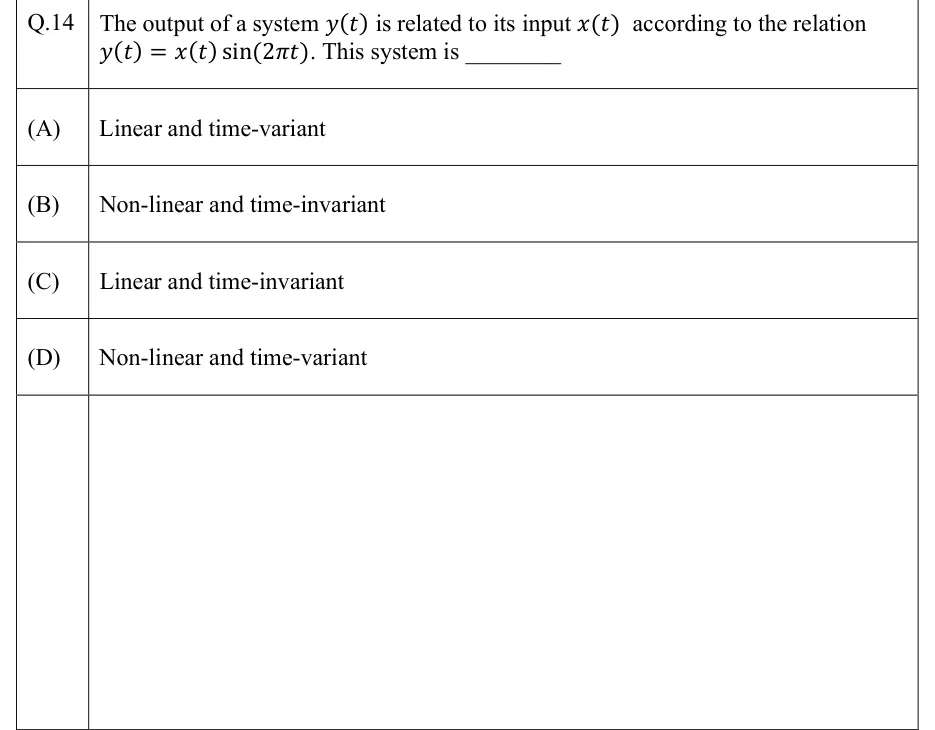
The output of a system is related to its input according to the relation . This system is ________
- (A)
Linear and time-variant
- (B)
Non-linear and time-invariant
- (C)
Linear and time-invariant
- (D)
Non-linear and time-variant

The output of a system is related to its input according to the relation . This system is ________
Linear and time-variant
Non-linear and time-invariant
Linear and time-invariant
Non-linear and time-variant
ANSWER
(A) Linear and time-variant. Superposition holds because the output is the input multiplied by a fixed function of time. Shifting the input does not shift the multiplier , so the system fails the shift test.
Official answer: ASource: Official answer key, GATE 2022 IN (IIT Kharagpur)
Linearity (superposition test). Let and . Apply for arbitrary constants : Additivity and homogeneity both hold, so the system is linear.
Check: a zero input gives , as every linear system must.
Time invariance (shift test). Delay the input by and pass it through the system. The multiplier is not part of the input, so it is not shifted:
Now delay the original output by , replacing every by :
These two must be equal for every input and every shift if the system is time-invariant. One counterexample is enough to show it is not. Take and . Then , while At : but . So , and the system is time-variant.
The reason is that the gain depends explicitly on time, outside the argument of . This is an amplitude modulator, which is linear but time-variant. Answer: (A).
KEY IDEA
If with a fixed function , the system is always linear, because multiplying by any fixed function distributes over sums and scalings. It is time-invariant only when is a constant. Any explicit outside the argument of (here ) makes the system time-variant.
WATCH OUT FOR
There are two common mistakes. The first is to shift the factor along with the input when checking time invariance. Only is delayed. The multiplier belongs to the system and stays at . The second is to test with an integer shift such as . Because , the outputs agree for that shift, and the student wrongly concludes the system is time-invariant. Time invariance must hold for every shift, so one failing shift like settles the question. Seeing and calling the system non-linear is also wrong: the sine acts on , not on .
From the GATE 2022 IN paper. Every question of this paper · Download the full paper · All 31 LTI & convolution questions, with notes