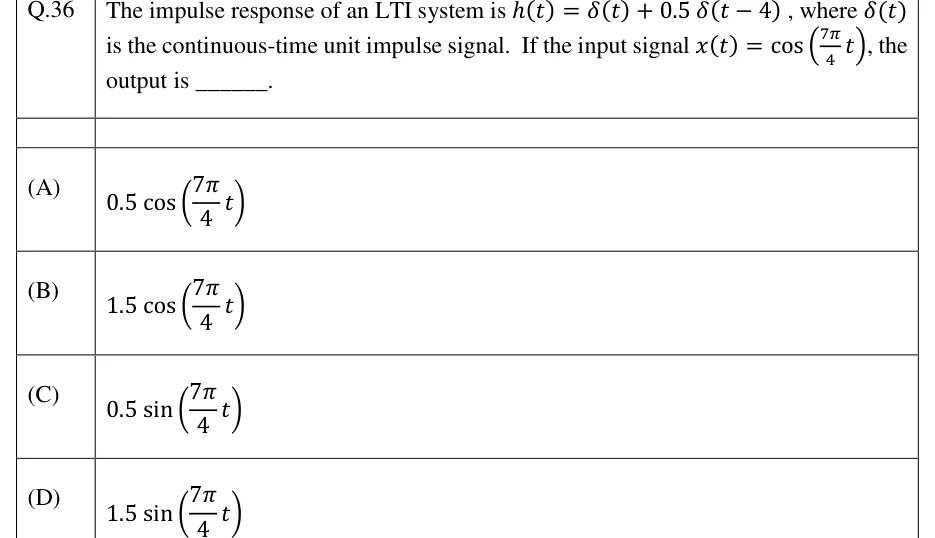
The impulse response of an LTI system is , where is the continuous-time unit impulse signal. If the input signal , the output is ______.
- (A)
- (B)
- (C)
- (D)

The impulse response of an LTI system is , where is the continuous-time unit impulse signal. If the input signal , the output is ______.
ANSWER
The output is , option (A).
Official answer: ASource: Official answer key, GATE 2023 IN (IIT Kanpur)
Convolving a signal with delays it by : . Convolution is linear, so
Substitute the input:
is an odd multiple of , so .
So
Check with the frequency response (a sinusoid is an eigenfunction of an LTI system): . At we get and , so . The output is the input scaled by with no phase shift, : option (A).
KEY IDEA
An impulse at in adds a copy of the input delayed by . Here the delay of 4 s is a phase lag of rad, an odd multiple of . That turns the delayed copy into , which cancels half of the direct term. Put another way, is at its minimum of , with zero phase, at this frequency.
WATCH OUT FOR
Adding the two impulse strengths without accounting for the delay () gives option (B). That is only right if the phase lag is an even multiple of . A second trap is thinking the delay turns cosine into sine (options C and D). A phase shift of only flips the sign; a sine would need an odd multiple of .
From the GATE 2023 IN paper. Every question of this paper · Download the full paper · All 31 LTI & convolution questions, with notes