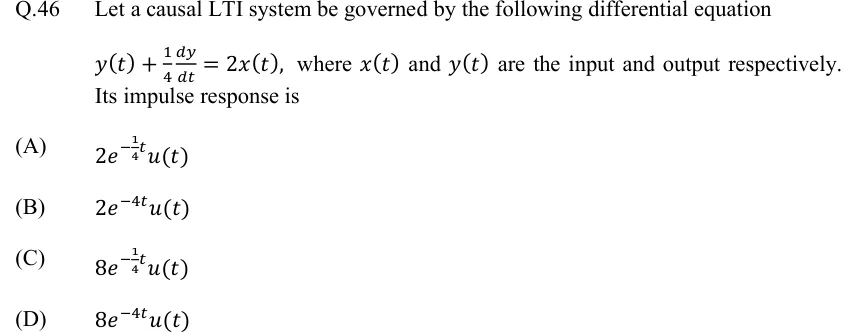
Let a causal LTI system be governed by the following differential equation
where and are the input and output respectively. Its impulse response is
- (A)
- (B)
- (C)
- (D)

Let a causal LTI system be governed by the following differential equation
where and are the input and output respectively. Its impulse response is
ANSWER
The impulse response is , which is option (D).
Official answer: DSource: Official answer key, GATE 2022 EE (IIT Kharagpur)
Take the Laplace transform with zero initial conditions. The impulse response of a causal LTI system described by a differential equation is found at initial rest, so every initial condition is zero:
Transfer function:
The system is causal, so take the right-sided inverse using with :
Check with the initial-value theorem, which applies because is strictly proper: . This rules out (A) and (B), which both start at 2.
Check the time constant. The pole at gives , so the exponent is , not . This rules out (C).
Direct check in the time domain: , so . That is the right-hand side with . The answer is (D).
KEY IDEA
For a first-order system , the transfer function is , so the impulse response is . Here and , so the gain is and the decay rate is .
WATCH OUT FOR
Reading the coefficient as the decay rate, which gives (options A and C), or keeping the right-hand-side gain 2 without dividing by the time constant (options A and B). You have to normalise the derivative coefficient to 1 first: .
From the GATE 2022 EE paper. Every question of this paper · Download the full paper · All 31 LTI & convolution questions, with notes