
IAE Academy

GATE 2022 EC Q.46: solution and answer

GATE 2022 · ECQ.46 · 2 marks · MSQ

The outputs of four systems (, , , and ) corresponding to the input signal , for all time , are shown in the figure.

Based on the given information, which of the four systems is/are definitely NOT LTI (linear and time-invariant)?
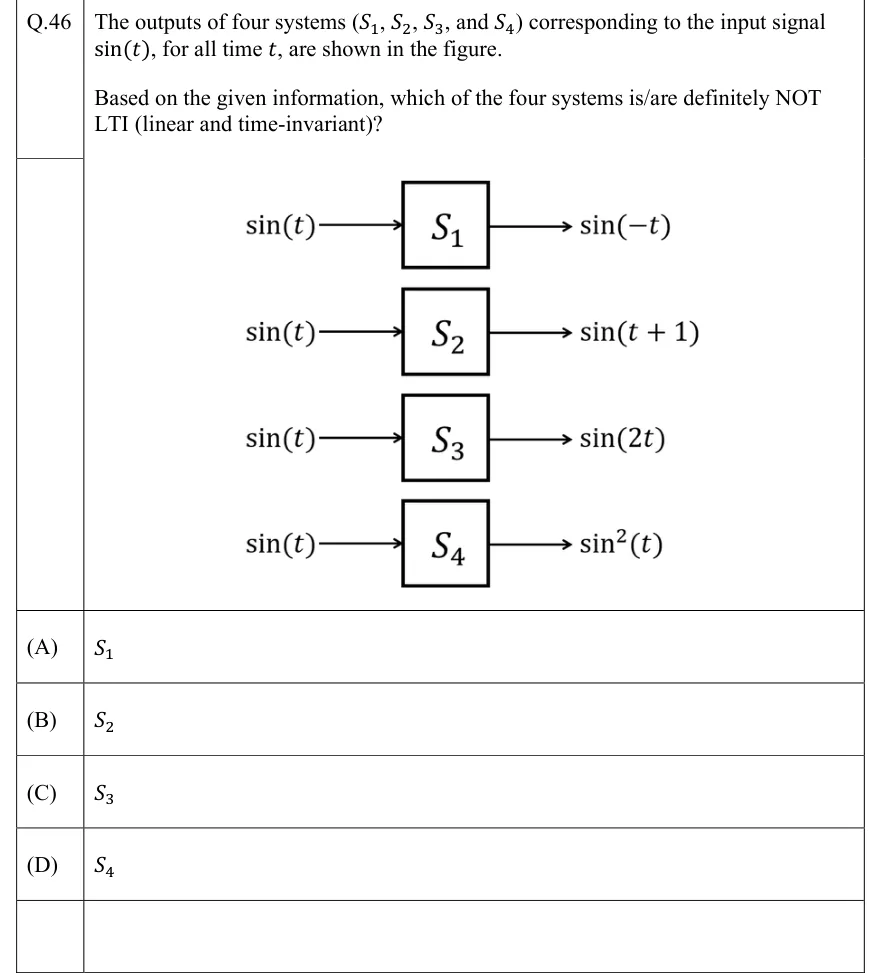
GATE 2022 EC question 46: Four separate blocks stacked vertically, each with input sin (t) on the left and an arrow to the output on the right: sin…Tap to open full size
Figure from the GATE 2022 EC paper. It is part of the question.
Figure description

Four separate blocks stacked vertically, each with input sin (t) on the left and an arrow to the output on the right: sin (t) → S_1 → sin (-t); sin (t) → S_2 → sin (t+1); sin (t) → S_3 → sin (2t); sin (t) → S_4 → sin^2(t).

  1. (A)

  2. (B)

  3. (C)

  4. (D)

Answer and solution

ANSWER

(C) and (D) . They are definitely NOT LTI, because their outputs contain frequencies that are not in the input (, plus a DC term for ). The outputs of and could come from LTI systems ( and ).

Official answer: C, DSource: Official answer key, GATE 2022 EC (IIT Kharagpur)

  1. Eigenfunction property of LTI systems: write . An LTI system maps to , so its response to is . For a real system this is . Either way the output contains only the same frequency , scaled and phase-shifted. An LTI system cannot create a new frequency or a DC term.

  2. : . This is the same frequency with gain and phase . The LTI system produces exactly this output. (So could the time reversal , which is not time-invariant, but one input cannot tell the two apart.) So is not definitely non-LTI.

  3. : is the input phase-shifted by at the same frequency. The LTI system (a time advance with ) produces it. That system is non-causal, but causality is not part of being LTI. So is not definitely non-LTI.

  4. : has frequency , and that frequency is not in the input. No LTI system can do this, so is definitely NOT LTI.

  5. : This has a DC term and a component, and neither is in the input. So is definitely NOT LTI.

  6. Cross-check without frequency response. Since , the input delayed by is the same signal as the input negated. If a system is LTI and , time-invariance says the response to is , and linearity says the response to is . So we need for all . : , which holds. : , which holds. : , which fails. : , which fails. This agrees with steps 2 to 5.

  7. One input-output pair can prove that a system is not LTI, but it can never prove that a system is LTI. That is why the question says "definitely NOT": and are consistent with an LTI system, while and rule one out. Answer: (C) and (D).

KEY IDEA

A sinusoid is an eigenfunction of every LTI system, so an LTI output for can only be scaled and phase-shifted: the same frequency, no new harmonics and no DC. A single input-output pair can prove a system is not LTI, but it can never prove that a system is LTI.

WATCH OUT FOR

Marking because looks like time reversal. In fact , which the LTI system produces. Marking because is non-causal is the same kind of mistake: causality is not part of being LTI. Another error is reading the question as asking which systems ARE LTI, when one input can only show whether an LTI system is possible.

From the GATE 2022 EC paper. Every question of this paper · Download the full paper · All 31 LTI & convolution questions, with notes

More LTI & convolution questions