
IAE Academy

GATE 2022 EC Q.26: solution and answer

GATE 2022 · ECQ.26 · 1 mark · MSQ

An ideal OPAMP circuit with a sinusoidal input is shown in the figure. The 3 dB frequency is the frequency at which the magnitude of the voltage gain decreases by 3 dB from the maximum value. Which of the options is/are correct?
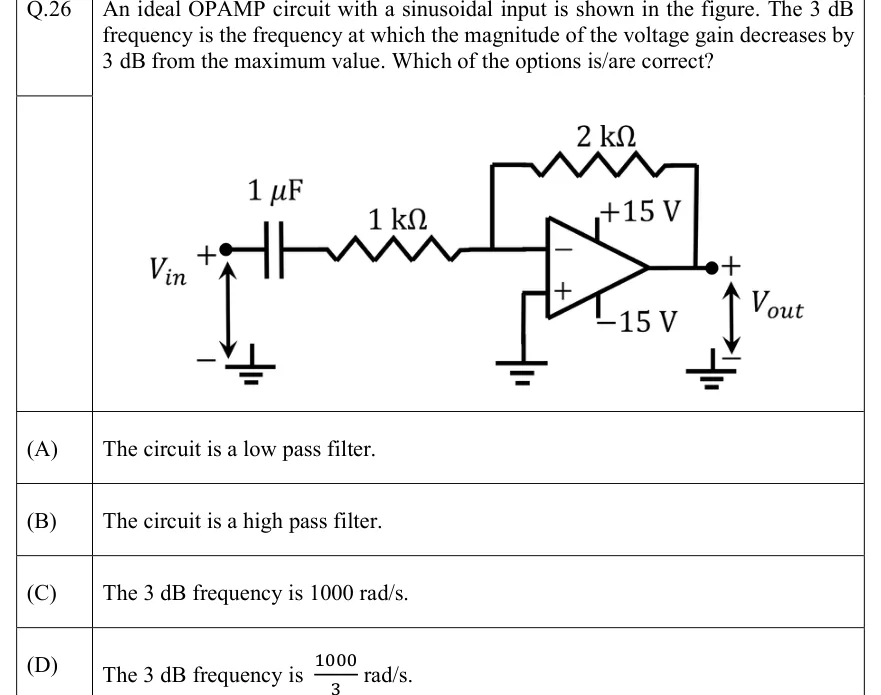
GATE 2022 EC question 26: Inverting op-amp stage.Tap to open full size
Figure from the GATE 2022 EC paper. It is part of the question.
Figure description

Inverting op-amp stage. The source V_in (+ on top, - to ground) connects through a 1 capacitor and then a 1 k Ω resistor in series to the op-amp's inverting (-) input. A 2 k Ω feedback resistor goes from the op-amp output back to the inverting input. The non-inverting (+) input is grounded. The op-amp supplies are +15 V and -15 V. V_out is taken between the op-amp output (+) and ground (-).

  1. (A)

    The circuit is a low pass filter.

  2. (B)

    The circuit is a high pass filter.

  3. (C)

    The 3 dB frequency is 1000 rad/s.

  4. (D)

    The 3 dB frequency is rad/s.

Answer and solution

ANSWER

(B) and (C) are correct. The circuit is a first-order high-pass filter with passband gain , and its 3 dB frequency is .

Official answer: B, CSource: Official answer key, GATE 2022 EC (IIT Kharagpur)

  1. Assume an ideal op-amp working in its linear region (the input amplitude is small enough that the output stays inside the supplies). The inputs are then virtually shorted, and because the input is grounded, the input sits at (virtual ground).

  2. Input impedance: the capacitor and the resistor are in series, so with and . The feedback impedance is .

  3. Inverting-amplifier gain:

  4. Limiting cases: as the capacitor acts as an open circuit and . As it acts as a short and . The gain rises from zero to a constant maximum, so the circuit is a first-order high-pass filter. (B) is correct and (A) is wrong.

  5. Magnitude: . The maximum is . The gain is 3 dB below that maximum when , which happens when .

  6. 3 dB frequency: So (C) is correct. sets only the passband gain and has no effect on the corner, so the in (D) is wrong.

KEY IDEA

Because of the virtual ground at the inverting input, the series – branch sees directly, so the gain is . That gives a single pole at and a zero at the origin, which is a high-pass response. The feedback resistor only scales the gain: it sets the passband level and does not move the corner.

WATCH OUT FOR

Option (D) comes from putting the total resistance into the time constant, which gives . The virtual ground isolates from the input branch, so only and set the corner. Another mistake is to see a capacitor and call the circuit a low-pass filter. A series input capacitor blocks low frequencies. Low-pass behaviour would need the capacitor in parallel with .

From the GATE 2022 EC paper. Every question of this paper · Download the full paper · All 13 Filters & waveforms questions, with notes

More Filters & waveforms questions