
IAE Academy

GATE 2024 EC Q.17: solution and answer

GATE 2024 · ECQ.17 · 1 mark · MCQ

In the circuit below, assume that the long channel NMOS transistor is biased in saturation. The small signal trans-conductance of the transistor is . Neglect body effect, channel length modulation and intrinsic device capacitances. The small signal input impedance is ________.
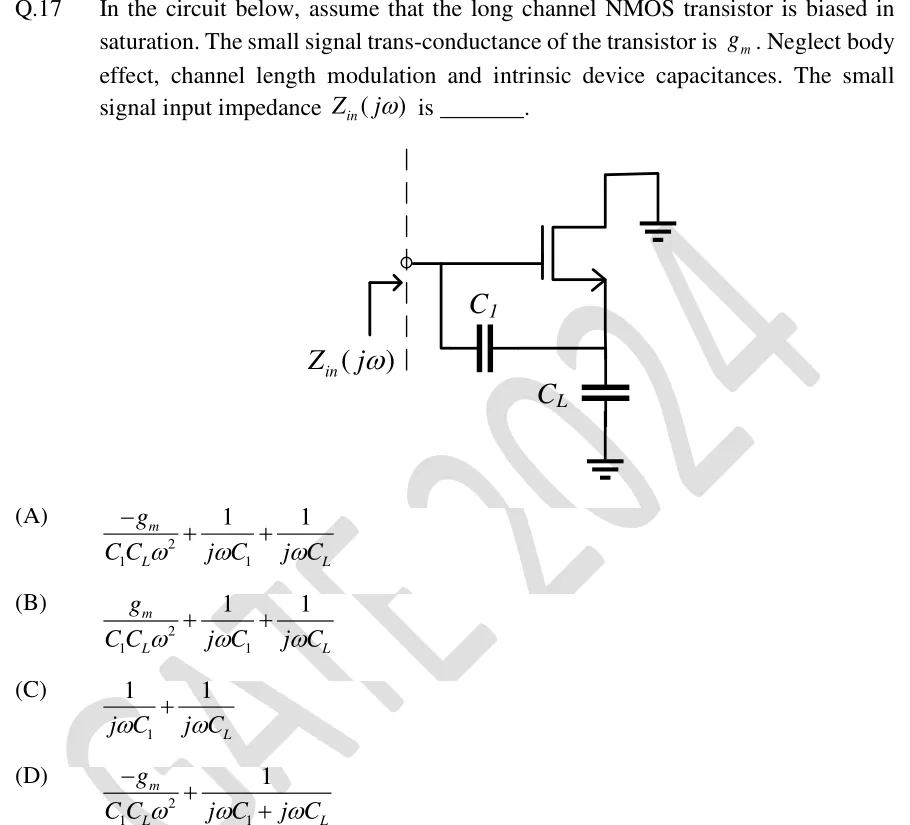
GATE 2024 EC question 17: An NMOS transistor.Tap to open full size
Figure from the GATE 2024 EC paper. It is part of the question.
Figure description

An NMOS transistor. Its drain goes to ground (drawn at the top right, going to a ground symbol). Its gate connects to the input node, marked with a small open circle on a dashed vertical line. An arrow labelled Z_in(j ω) points into this node. The source (arrow on the source lead, pointing out) connects to a node X. Capacitor C_1 runs from the gate/input node to node X, so it sits between gate and source. Capacitor C_L runs from node X to ground. No resistors or other components; bias is not shown (the device is assumed to be in saturation).

  1. (A)

  2. (B)

  3. (C)

  4. (D)

Answer and solution

ANSWER

, option (A).

Official answer: ASource: Official answer key, GATE 2024 EC (IISc Bengaluru)

  1. Small-signal model. The drain is tied to ground, so it is at AC ground. In saturation the MOSFET is a voltage-controlled current source that carries current from drain to source. As the question says, take (no channel-length modulation), ignore body effect and leave out and . Apply a test voltage at the gate and let be the current it drives into the gate node. Call the source-node voltage .

  2. Current through . The gate draws no current, so all of flows through from the gate to the source node. Since sits directly between gate and source, the voltage across it is :

  3. KCL at the source node. Two currents flow in: through and from the transistor (drain to source). The only path out is to ground:

  4. KVL from gate to ground. , so

  5. Simplify. Since : This is option (A). The capacitors and appear in series, and the transistor adds a negative real part . That frequency-dependent negative resistance is what sustains oscillation in a Colpitts oscillator.

KEY IDEA

Drive the gate with a test source. With no gate current, flows entirely through , so . The dependent current joins in charging . The result is the two capacitors in series plus a term , which is a negative real resistance. This is the standard negative-resistance cell at the heart of the Colpitts oscillator.

WATCH OUT FOR

There are three common slips. (1) Treating as , which flips the sign and gives option (B). (2) Leaving out the current in the KCL at the source, which leaves only the series capacitors, option (C). (3) Combining and as if they were in parallel, which gives option (D). They are in series here: the same current flows through , and the voltages across and add up to .

From the GATE 2024 EC paper. Every question of this paper · Download the full paper · All 20 Amplifiers questions, with notes

More Amplifiers questions