
IAE Academy

GATE 2024 EE Q.26: solution and answer

GATE 2024 · EEQ.26 · 1 mark · MCQ

To obtain the Boolean function , the inputs in the figure should be
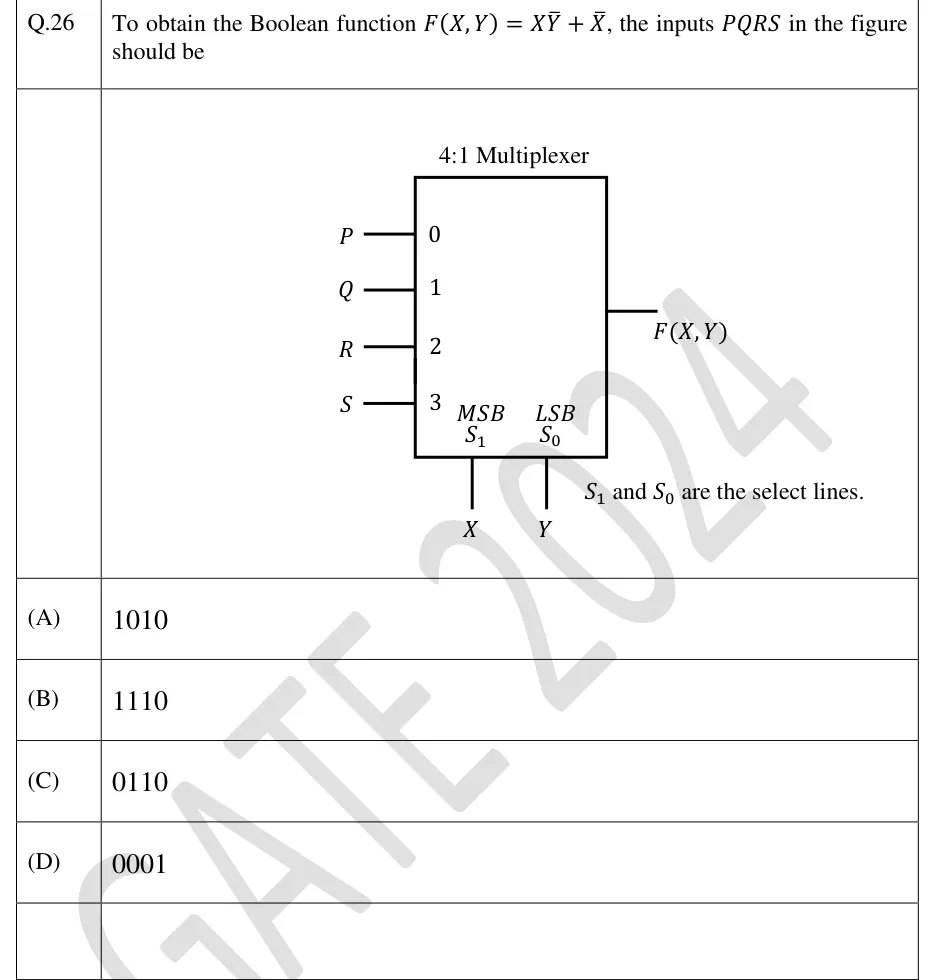
GATE 2024 EE question 26: A 4:1 multiplexer drawn as a box labelled '4:1 Multiplexer'.Tap to open full size
Figure from the GATE 2024 EE paper. It is part of the question.
Figure description

A 4:1 multiplexer drawn as a box labelled '4:1 Multiplexer'. Data inputs on the left: P to input 0, Q to input 1, R to input 2, S to input 3. Output on the right labelled F(X,Y). Two select lines at the bottom: S_1 (marked MSB) driven by X, and S_0 (marked LSB) driven by Y. A note reads: 'S_1 and S_0 are the select lines.'

  1. (A)

    1010

  2. (B)

    1110

  3. (C)

    0110

  4. (D)

    0001

Answer and solution

ANSWER

, option (B). The function simplifies to , which is 0 only when , so only input 3 () is tied to 0.

Official answer: BSource: Official answer key, GATE 2024 EE (IISc Bengaluru)

  1. How a 4:1 MUX works here: is the MSB and is the LSB, so the output is . This means data input must equal the value of at the minterm . (An overline means complement.)

  2. Simplify first with the absorption rule , taking : . That is a two-input NAND.

  3. Work out for each select combination. : , so and . : , so and .

  4. : , so . : , so .

  5. So . This is the NAND truth table read in the order , which is option (B).

KEY IDEA

In an -select MUX used as a function generator, data input is simply the value of at the minterm whose binary code, with the MSB select line as the leading bit, equals . Here drives the MSB, so the input order matches .

WATCH OUT FOR

Mixing up which select line is the MSB. If you take as the MSB, inputs 1 and 2 swap places. That gives the same pattern here only because is symmetric in and , so it will not work in general. A second slip is to read only the term, mark just input 2 as 1, and forget that also covers inputs 0 and 1.

From the GATE 2024 EE paper. Every question of this paper · Download the full paper · All 12 Combinational questions, with notes

More Combinational questions