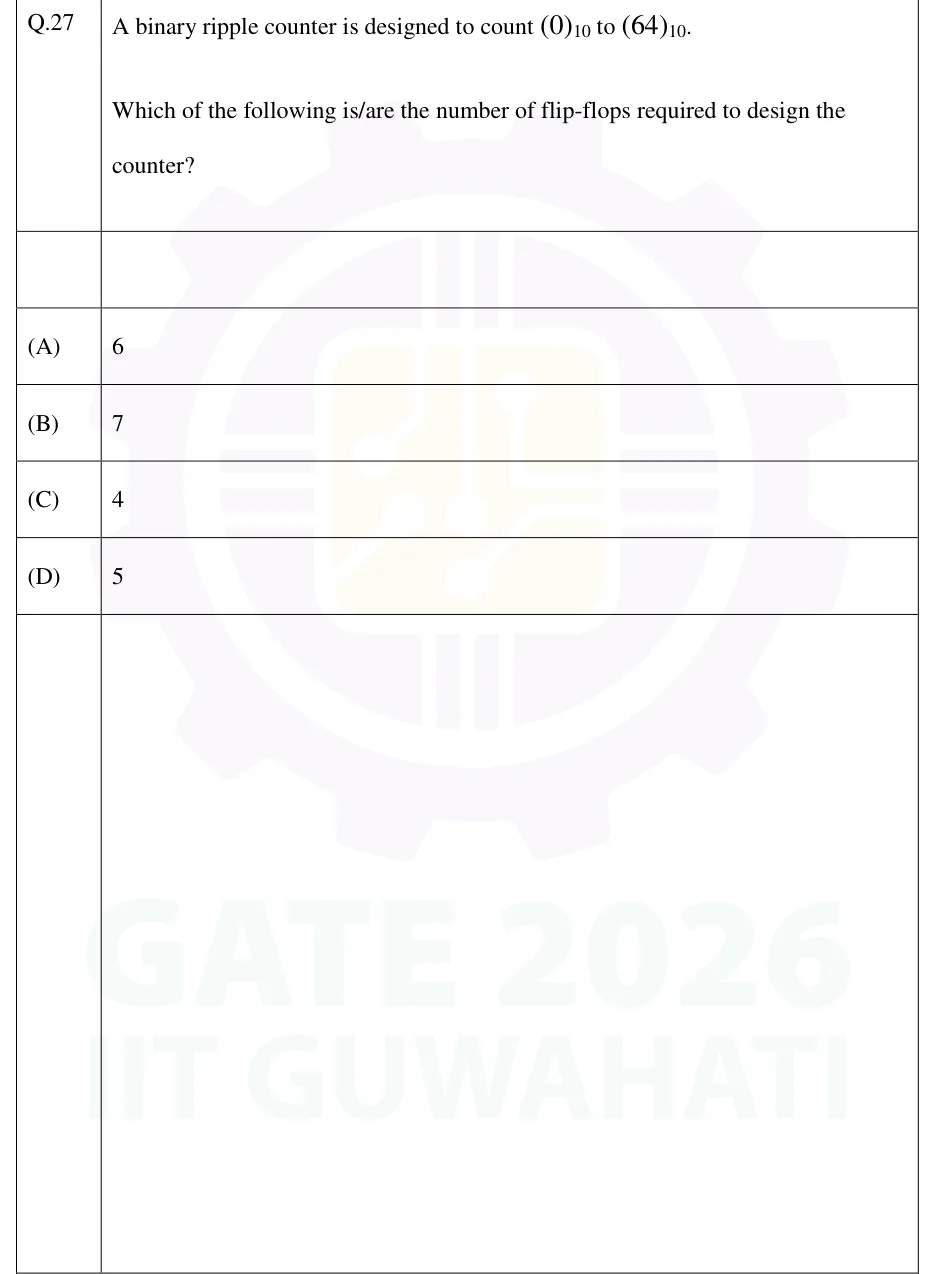
A binary ripple counter is designed to count to .
Which of the following is/are the number of flip-flops required to design the counter?
- (A)
6
- (B)
7
- (C)
4
- (D)
5

A binary ripple counter is designed to count to .
Which of the following is/are the number of flip-flops required to design the counter?
6
7
4
5
ANSWER
(B) 7 flip-flops. Counting 0 to 64 takes 65 states, and 7 is the smallest with ( is one short).
Official answer: BSource: Official answer key, GATE 2026 EC (IIT Guwahati)
Count the states. A counter that runs from to must pass through distinct states.
Apply the flip-flop count rule. flip-flops can hold at most distinct states, so the counter needs the smallest with .
Check : . Six flip-flops count only up to , so they cannot represent the state 64.
Check : . The largest count needed, , is a 7-bit number, so a seventh flip-flop is needed.
Check the options. 4, 5 and 6 flip-flops all give fewer than 65 states. Of the numbers offered, only 7 is enough. The 7-bit ripple counter is cut down to a MOD-65 counter by clearing all flip-flops as soon as it reaches , the first state where and are both 1.
Answer: (B) only.
KEY IDEA
A counter with distinct states needs the smallest with . Counting from 0 to gives states, so the number of flip-flops equals the number of bits in the largest count : here has 7 bits.
WATCH OUT FOR
Taking instead of 65 and picking 6 because . Six flip-flops count 0 to 63, which is 64 states, and cannot hold the state 64 itself. When counting starts at 0, the final count needs one more bit than you might first expect.
From the GATE 2026 EC paper. Every question of this paper · Download the full paper · All 30 Sequential questions, with notes