
IAE Academy

GATE 2026 EC Q.35: solution and answer

GATE 2026 · ECQ.35 · 1 mark · NAT

The negative edge triggered JK flip-flop in the Figure has J and K inputs tied to Logic High and a square wave of 10 cycles/second is applied to its clock (C) input.

The frequency of the output Q (in cycles/second) is ____. (rounded off to two decimal places)
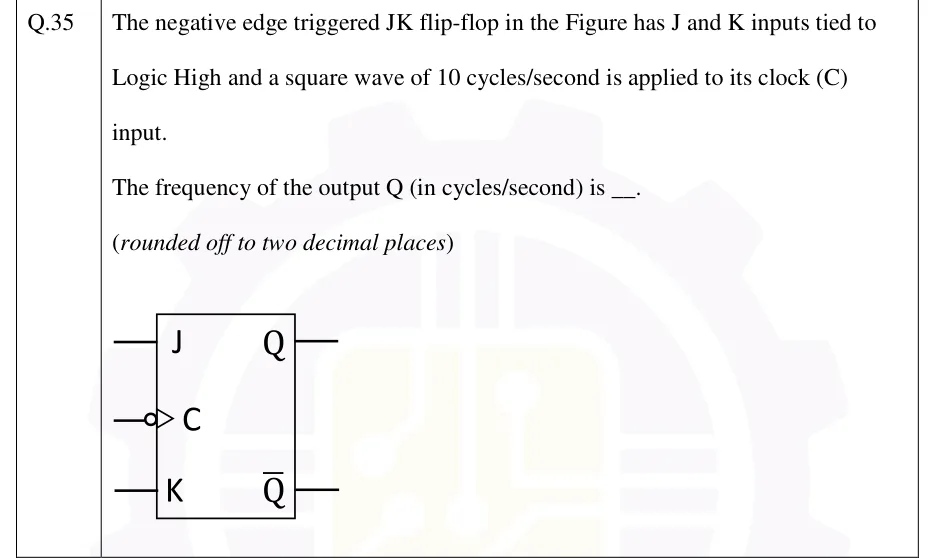
GATE 2026 EC question 35: A single JK flip-flop drawn as a rectangle.Tap to open full size
Figure from the GATE 2026 EC paper. It is part of the question.
Figure description

A single JK flip-flop drawn as a rectangle. Inputs on the left side: J (top), clock input C (middle) drawn with a bubble followed by the triangle clock symbol, marking negative-edge triggering, and K (bottom). Outputs on the right side: Q (top) and Q-bar (bottom). Each terminal is a short line with no further connections drawn. The text says J and K are tied to logic High and a 10 cycles/second square wave drives C.

Answer and solution

ANSWER

The output frequency is .

Official answer: 4.90 to 5.10Source: Official answer key, GATE 2026 EC (IIT Guwahati)

  1. Characteristic equation of the JK flip-flop: , where the overline means complement.

  2. With : . The flip-flop is in toggle mode.

  3. The flip-flop is negative-edge triggered, so toggles once on every falling edge of the clock. A square wave has one falling edge per cycle, so there are falling edges every second.

  4. One full cycle of needs two toggles (low to high, then high back to low), so one cycle of takes 2 clock cycles.

  5. Rounded to two decimal places: . Which edge triggers the flip-flop changes when 's edges happen, but not how often they happen, so the frequency is unchanged.

KEY IDEA

With , a JK flip-flop toggles on every active clock edge (). A full output cycle needs two toggles, so the flip-flop works as a divide-by-2 counter: . The triggering edge (rising or falling) only moves where the output transitions fall in time. It does not change their rate.

WATCH OUT FOR

One mistake is to count each toggle as a full output cycle and answer 10, which is the clock frequency. Another is to think negative-edge triggering changes the frequency, for example by counting both clock edges and answering 10 or 20. An edge-triggered flip-flop responds to only one edge per clock cycle, and it takes two toggles to complete one cycle of .

From the GATE 2026 EC paper. Every question of this paper · Download the full paper · All 30 Sequential questions, with notes

More Sequential questions