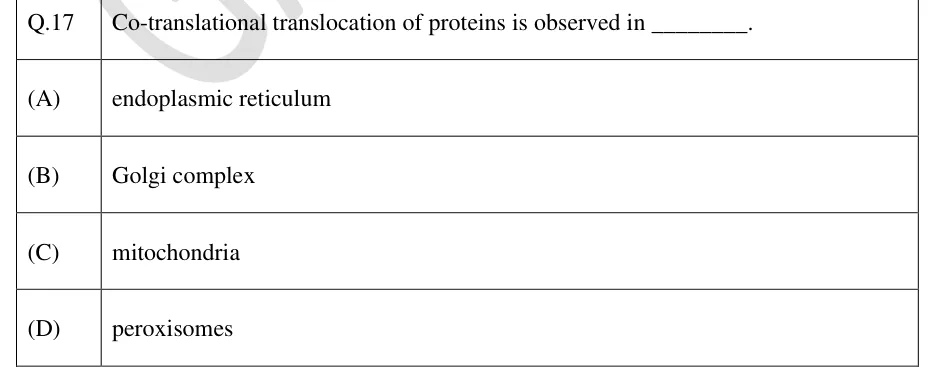
Co-translational translocation of proteins is observed in ________.
- (A)
endoplasmic reticulum
- (B)
Golgi complex
- (C)
mitochondria
- (D)
peroxisomes

Co-translational translocation of proteins is observed in ________.
endoplasmic reticulum
Golgi complex
mitochondria
peroxisomes
ANSWER
Co-translational translocation of proteins is observed in the endoplasmic reticulum (Option A).
Official answer: ASource: Official answer key, GATE 2024 BT (IISc Bengaluru)
Co-translational translocation means the polypeptide is threaded into or across a membrane while it is still being synthesized on the ribosome, not after release into the cytosol.
Option A (ER): The signal sequence emerging from the ribosome is recognized by the signal recognition particle (SRP), which pauses translation and targets the ribosome-nascent chain complex to the SRP receptor on the rough ER membrane. The chain is then threaded through the Sec61 translocon as translation resumes - the defining example of co-translational translocation. Option A is correct.
Option B (Golgi complex): The Golgi receives proteins by vesicular transport from the ER only after they have already been translated and translocated into the ER lumen; no ribosome-coupled translocation occurs at the Golgi. Option B is wrong.
Option C (mitochondria): Mitochondrial matrix and inner-membrane proteins are synthesized on free cytosolic ribosomes, released as complete or nearly complete chains, kept unfolded by cytosolic chaperones such as Hsp70, and imported afterward through the TOM/TIM complexes - this is post-translational import, not co-translational. Option C is wrong.
Option D (peroxisomes): Peroxisomal matrix proteins are likewise fully synthesized and folded in the cytosol, then imported post-translationally via PTS1/PTS2 signals recognized by the Pex5/Pex7 receptors (peroxisomes can even import folded, oligomeric proteins). Option D is wrong.
Only the ER pathway couples translation and translocation in real time, so the answer is (A) endoplasmic reticulum.
KEY IDEA
Co-translational translocation means the nascent polypeptide is threaded into/across a membrane while translation is still ongoing; this is the defining feature of the SRP-Sec61 pathway into the rough ER, whereas mitochondrial and peroxisomal import (and Golgi delivery) occur post-translationally.
WATCH OUT FOR
Confusing co-translational translocation (ER, via SRP/Sec61, threading the chain in as it is synthesized) with post-translational import (mitochondria via TOM/TIM, peroxisomes via PTS1/PTS2/Pex5-Pex7), where the full-length or nearly full-length protein is imported only after release from the ribosome.
From the GATE 2024 BT paper. Every question of this paper · Download the full paper · All 15 Cell biology questions, with notes