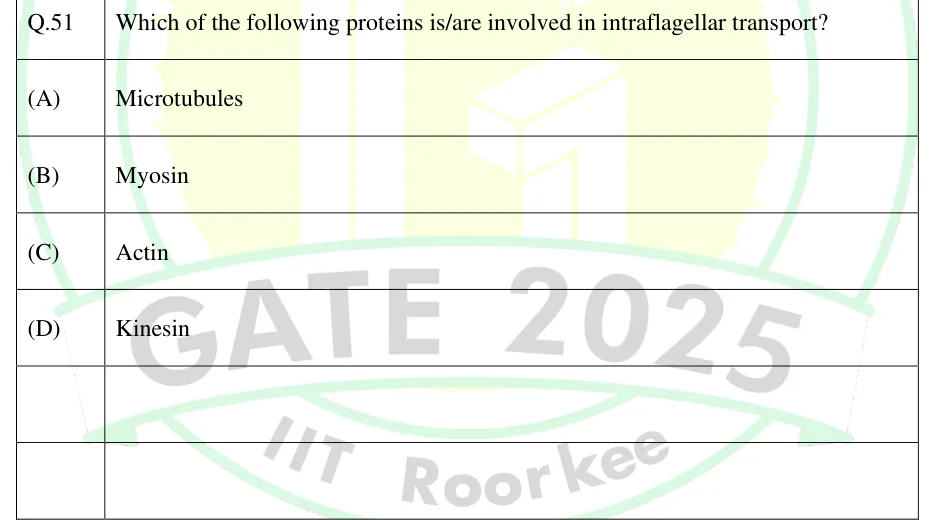
Which of the following proteins is/are involved in intraflagellar transport?
- (A)
Microtubules
- (B)
Myosin
- (C)
Actin
- (D)
Kinesin

Which of the following proteins is/are involved in intraflagellar transport?
Microtubules
Myosin
Actin
Kinesin
ANSWER
The correct options are (A) Microtubules and (D) Kinesin.
Official answer: A, DSource: Official answer key, GATE 2025 BT (IIT Roorkee)
Intraflagellar transport (IFT) is the movement of particulate cargo — axonemal precursor proteins and signaling molecules — bidirectionally along the length of a cilium/flagellum, between the ciliary membrane and the underlying axoneme.
The axoneme, which also serves as the track for IFT, is built of microtubule doublets (polymers of the protein tubulin). Since microtubules form the structural track along which IFT particles move, Option (A) Microtubules is correct.
Anterograde IFT (movement from the base of the cilium to the tip) is driven by the motor protein kinesin-2, which walks along the microtubule doublets carrying IFT-B particle trains and their cargo. Hence Option (D) Kinesin is correct.
Retrograde IFT (tip to base) is driven by cytoplasmic dynein-2, not myosin. Myosin is a motor protein that moves along actin filaments — a distinct cytoskeletal system unrelated to ciliary/flagellar transport — so Option (B) Myosin is not involved in IFT.
Actin filaments are not components of the axoneme and do not participate in the IFT machinery, which is exclusively microtubule- and kinesin/dynein-based; so Option (C) Actin is not involved in IFT.
Therefore, the proteins involved in intraflagellar transport are Microtubules (the track) and Kinesin (the anterograde motor) — Options (A) and (D).
KEY IDEA
Intraflagellar transport (IFT) is the bidirectional movement of protein cargo (axonemal precursors, signaling proteins) along the axoneme of a cilium/flagellum, between its base and tip. The axoneme itself (the transport track) is built of microtubule doublets. Anterograde (base→tip) movement of IFT trains is powered by kinesin-2 motors walking along these microtubules; retrograde (tip→base) movement uses cytoplasmic dynein-2. Actin and myosin belong to a separate cytoskeletal transport system and are not part of the ciliary/flagellar IFT machinery.
WATCH OUT FOR
Confusing the microtubule/kinesin-based IFT system (cilia/flagella) with the actin/myosin-based cytoskeletal transport system used elsewhere in the cell (e.g., cortical transport, melanosome movement) — actin and myosin play no role inside the flagellum/IFT machinery.
From the GATE 2025 BT paper. Every question of this paper · Download the full paper · All 15 Cell biology questions, with notes