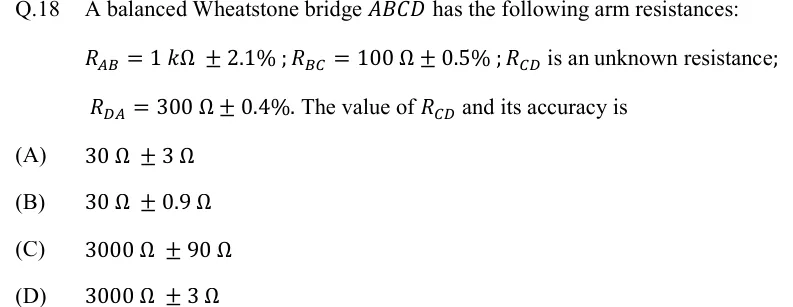
A balanced Wheatstone bridge has the following arm resistances:
; ; is an unknown resistance; . The value of and its accuracy is
- (A)
- (B)
- (C)
- (D)

A balanced Wheatstone bridge has the following arm resistances:
; ; is an unknown resistance; . The value of and its accuracy is
ANSWER
, option (B).
Official answer: BSource: Official answer key, GATE 2022 EE (IIT Kharagpur)
The arms go round the loop , so arm is opposite arm and arm is opposite arm .
Balance condition. With the supply across – and the detector across –, no detector current flows when and are at the same potential, which means the two dividers split the supply in the same ratio: In words, the products of opposite arms are equal. Putting the supply across – instead gives the same condition.
Limiting (worst-case) error of a product or quotient: the relative (percentage) errors of all the factors add, whether a factor multiplies or divides. For , .
Absolute error: .
So , which is option (B).
KEY IDEA
At balance, the products of opposite arms of a Wheatstone bridge are equal: . When the unknown is a product or quotient of the other arms, its limiting percentage error is the sum of their percentage errors. You then turn that percentage into ohms using the computed value.
WATCH OUT FOR
Pairing the wrong arms. Writing gives options (C) or (D). Another trap is reading the relative error as , which gives option (A). A third is subtracting the error of the divisor arm, : in a limiting-error calculation, relative errors always add.
From the GATE 2022 EE paper. Every question of this paper · Download the full paper · All 11 Errors & standards questions, with notes